Words and Music

Commuting days until retirement: 360

Words and MusicThis piece was kicked off by some comments I heard from the poet Sean O’Brien on a recent radio programme. Speaking on the BBC’s Private Passions, where guests choose favourite music, and talking about Debussy, he said:

Poetry is always envious of music because that’s what poetry wants to be, whereas music has no need to be poetry. So [poets] are always following in the wake of music – but the two come quite close in sensibility here, it seems to me.

Discuss. Well, for me this immediately brought to mind a comment I once heard attributed to the composer Mendelssohn, to the effect that ‘music is not too vague for words, but too precise.’ So I went and did some Googling, and here’s the original quote:

People often complain that music is too ambiguous, that what they should think when they hear it is so unclear, whereas everyone understands words. With me, it is exactly the opposite, and not only with regard to an entire speech but also with individual words. These, too, seem to me so ambiguous, so vague, so easily misunderstood in comparison to genuine music, which fills the soul with a thousand things better than words. The thoughts which are expressed to me by music that I love are not too indefinite to be put into words, but on the contrary, too definite.

(Source: Wikiquote, where you can also see the original German.)

These two statements seem superficially similar – are they saying the same thing, from different standpoints? One difference, of course, is that O’Brien is specifically talking of poetry rather than words in general. In comparison with prose, poetry shares more of the characteristics of music: it employs rhythm, cadence, phrasing and repetition, and is frequently performed rather than read from the page; and music of course is virtually exclusively a performance art. So that’s a first thought about how poetry departs from the prosaic and finds itself approaching the territory inhabited by music.

But what is the precision which Mendelssohn insists is music’s preserve? It’s true that music is entirely bound up with the mathematics of sound frequency ratios in intervals between notes: it was this that gave Pythagoras and others their obsession with the mystique of numbers, in antiquity. A musician need not be grounded deeply in mathematical theory, but but he or she will always be intensely aware of the differing characters of musical intervals – as is anyone who enjoys music at all, if perhaps more indirectly.

I haven’t read a lot of theorising on this topic, but it seems to me that there is a strong link here with everyday speech. In my own language, as, I should imagine, in most others, pitch and phrasing indicate the emotional register of what you are saying, and hence an important element of the meaning. One can imagine this evolving from the less articulate cries of our ancestors, with an awareness of intervals of pitch developing as a method of communication, hence fostering group cohesion and Darwinian survival value. Indeed, in some languages, such as Chinese, intonation can be integral to the meaning of a word. And there’s scientific evidence of the closeness of music and language: here’s an example.

So, going back to Mendelssohn, it’s as if music has developed by abstracting certain elements from speech, leaving direct, referential meaning behind and evolving a vocabulary from pitch, timbre and the free-floating emotional states associated with them. Think for a moment of film music. It can be an interesting exercise, in the middle of a film or TV drama, to make yourself directly aware of the background music, and then imagine how your perception of what is happening would differ if it were absent. You come to realise that the music is often instructing you what to feel about a scene or a character, and it often connects with your emotions so directly that it doesn’t consciously occur to you that the feelings you experience are not your own spontaneous ones. And if you add to this the complex structures formed from key relationships and temporal development, which a professional musician would be particularly aware of, you can start to see what Mendelssohn was talking about.

The musical piece O’Brien was introducing was the ‘Dialogue between the wind and the sea’ from Debussy ‘s La Mer. In other words,a passage which seeks to evoke a visual and auditory scene, rather than simply exploring musical ideas and the emotions that arise directly from them. By contrast, we could imagine a description of such a scene in prose: to be effective the writer needs to choose the words whose meanings and associations come together in such a way that readers can recreate the sensory impressions, and and the subjective impact of the scene in their own minds. The music, on the other hand, can combine its direct emotional access with an auditory picture, in a highly effective way.
Rain Steam and Speed

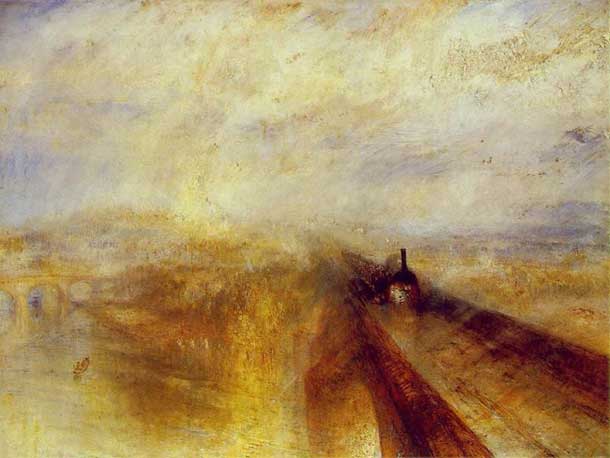
Rain, Steam and Speed – J.M.W Turner (National Gallery, London)

I was trying to think of an equivalent in visual art, and and the painting that came to mind was this one, with its emphasis on the raw sensory feelings evoked by the scene, rather than a faithful (prosaic) portrayal. In his use of this technique, Turner was of course controversial in his time, and is now seen as a forerunner of the impressionist movement. Interestingly, what I didn’t know before Googling the painting was that he is also known to have influenced Debussy, who mentions him in his letters. Debussy was also sometimes spoken of as impressionist, but he hated this term being applied to his work, and here is a quote from one of those letters:

I am trying to do something different – an effect of reality… what the imbeciles call impressionism, a term which is as poorly used as possible, particularly by the critics, since they do not hesitate to apply it to Turner, the finest creator of mysterious effects in all the world of art.

I like to think that perhaps Debussy is also to some extent lining up with Mendelssohn here, and, beside his reference to Turner’s painting, maybe has in mind the unique form of access to our consciousness which music has, as opposed to other art forms. A portrayal in poetry would perhaps come somewhere between prose and music, given that poetry, as we’ve seen, borrows some of music’s tricks. I looked around for an example of a storm at sea in poetry: here’s a snippet from Swinburne, around the turn of the 20th century, describing a storm in the English Channel.

As a wild steed ramps in rebellion, and and rears till it swerves from a backward fall,
The strong ship struggled and reared, and her deck was upright as a sheer cliff’s wall.

In two lines here we have – besides two similes with one of them extended into a metaphor – alliteration, repetition and rhyme, all couched in an irregular, bucking rhythm which suggests the movement of the ship with the sea and wind. Much in common here, then, with a musical evocation of a storm. This I take to be part of what O’Brien means by poetry ‘wanting’ to be music, and being ‘close in sensibility’ in the example he was talking about.

But I don’t see how all this implies that we should somehow demote poetry to an inferior role. Yes, it’s true that words don’t so often trigger emotions as directly, by their sound alone, as does music – except perhaps in individual cases where someone has become sensitised to a word through experience. But the Swinburne passage is an example of poetry flexing the muscles which it alone possesses, in pursuit of its goal. And even when its direct purpose is not the evocation of a specific scene, the addition of the use of imagery to the auditory effects it commands can create a very compelling kind of ‘music’. A couple of instances that occur to me: first T. S. Eliot in Burnt Norton, from The Four Quartets.

Garlic and sapphires in the mud
Clot the bedded axle-tree.
The trilling wire in the blood
Sings below inveterate scars
Appeasing long-forgotten wars.

I’m vaguely aware that there all sorts of allusions in the poet’s mind which are beyond my awareness, but just at the level of the sound of the words combined with the immediate images they conjure, there is for me a magic about this which fastens itself in my mind, making it intensely enjoyable to repeat the words to myself, I just as a snatch of music can stick in the consciousness. Another example, from Dylan Thomas, known for his wayward and idiosyncratic use of language. This is the second stanza from Especially When the October Wind:

Shut, too, in a tower of words, I mark
On the horizon walking like the trees
The wordy shapes of women, and the rows
Of the star-gestured children in the park.
Some let me make you of the vowelled beeches,
Some of the oaken voices, from the roots
Of many a thorny shire tell you notes,
Some let me make you of the water’s speeches.

Again, I find pure pleasure in the play of sounds and images here, before ever considering what further meaning there may be. But what I also love about the whole poem (here is the poet reading it) is the way it is self-referential: while exploiting the power of words, it explicitly links language-words to  images – ‘vowelled beeches’ rhymed with ‘water’s speeches’. The poet himself is ‘shut in a tower of words’ .

But, returning to the comparison with music, there’s one obvious superficial difference between it and language, namely that language is generally ‘about’ something, but while music is not. But of course there are plenty of exceptions: music can be, at least in part, deliberately descriptive, as we saw with Debussy, he while poetry often does away with literal meaning to transform itself into a sort of word-music, as I’ve tried to show above. And another obvious point I haven’t made is that words and music are often – perhaps more often than not – yoked together in song. The voice itself can simultaneously be a musical instrument and a purveyor of meaning. And it may be that the music is recruited to add emotional resonance to the language – think opera or musical drama – or that the words serve to give the music a further dimension and personality, as often in popular music. In the light of his statement above, it’s interesting that Mendelssohn is famous particularly for his piano pieces entitled Songs Without Words. The oxymoron is a suggestive one, and he strongly resisted an attempt by a friend to put words to them.

But the question of what music itself is ‘about’ is a perplexing, and perhaps profound one. I am intending this post to be one approach to the philosophical question of how it’s possible for one thing to be ‘about’ another: the topic known as intentionality. In an interesting paper, Music and meaning, ambiguity and evolution, Ian Cross of the Cambridge Faculty of Music explores this question (1), referring to the fact that the associations and effects of a piece of music may differ between the performer and a listener, or between different listeners. Music has, as he puts it, ‘floating intentionality’. This reminds me of a debate that has taken place about the performance of early music. For authenticity in, say 16th century music, some claim, it’s essential that it is played on the instruments of the time. Their opponents retort that you won’t achieve that authenticity unless you have a 16th century audience as well.

Some might claim that most music is not ‘about’ anything but itself, or perhaps about the emotions it generates. I am not intending to come to any conclusion on that particular topic, but just to raise some questions in a fascinating area. In the next post I intend to approach this topic of intentionality from a completely different direction.


1. Cross, Ian: Music and meaning, ambiguity and evolution, in D. Miell, R. MacDonald & D. Hargreaves, Musical Communication, OUP, 2004.
You can read part of it here.

The Boiling Frog

Commuting days until retirement: 370

In my post a while back about psychogeography, I mentioned a book called Tunnel Visions by Christopher Ross. Ross is the man who took a job as a station assistant on the London Underground, primarily just to observe and reflect on his fellow humans as they travelled, the very readable result being this book. I had mislaid it in the disordered book-drifts that lie about our house, but finding it again recently I re-read it. In the book Ross mentions a previous professional job which he left in order to travel and experience other cultures – he occasionally refers to these by way of contextualising some of our own peculiarities. Returning to England, he took the Underground job to further his own particular philosophical investigations. I was interested to find that, in the book’s Amazon reviews, there’s one by someone who came across him in his original job, and and mentions that he was a very capable tax lawyer. Evidently his need to engage with the world in a fresh way outweighed any material benefits or intellectual satisfaction in the job. Here’s his preferred metaphor for the fate he had escaped:

Boiling frog

Wikimedia Commons / Arthur G Cox

The boiling frog was a favourite object lesson and it was always hopping into my mind. In order to push back the boundaries of scientific discovery, scientists found out that frogs have nervous systems poorly adapted to register slow incremental change. So if you sit one in a saucepan of water and slowly heat it, the poor frog will stay where it is and boil to death.
We become chiropodists and lawn mower salesmen by a series of imperceptible ‘choices’ and by the time we realise what we’ve done, we’re boiled.

Well, I’ve no doubt that the world is replete with happy and fulfilled chiropodists and lawn mower salesmen, but you know what he means. Of course there are those who have a life plan settled in their minds when they are barely out of childhood, and proceed to stick to it – I’ve met one or two. Michael Heseltine, the former Conservative minister, famously wrote his down on the back of an envelope at the start of his career. It involved making a lot of money, entering parliament, and audaciously ended with ‘Prime Minister’. Only that last step eluded him.

And there are those like Ross himself – the free spirits – who are determined to try and make the world yield up its secrets by taking a more fresh and unconventional approach, probably giving up much comfort and prosperity in order to do so.

But most of us are much more like the frog. You start off in the career stakes with one of the jobs that happen to be there when you need one – most likely the one where your personality chances to gel with the people in the interview. And sooner or later you happen to see an ad for another job with a better salary, and which you realise you now have the experience for – and so on. And by this time you may have children who need feeding and housing, and you can’t step off the treadmill even if you want to.

I rather think, looking around the train at my fellow commuters, that some of them have the air of well-cooked amphibians. Maybe I can claim not to be thoroughly boiled, but can’t deny that I am at least lightly braised. I envy Ross his courage and independence, but I wouldn’t have given up the chance to raise children: parents can find at least as much fulfillment, and valuable life experience, as any philosophical nomad.

Maybe that’s something he still aims to fit his life around; I don’t know – he doesn’t say. I have searched the internet to find out what he’s been up to in the 12 years or so since the book was published,  but haven’t found anything. But I doubt whether he’s fallen back into the evil scientist’s flask.

What about you? I’d like to hear whether you consider yourself to be gently simmering, or good, fresh and raw.

Watching the World Go By

Commuting days until retirement: 381

Not another description of me, looking out of the window of my commuter train, but a few thoughts prompted by looking at some early film footage. A recent programme on Channel 4 looked at the rise of Hitler, using contemporary film from the 1920s and 1930s, which had been digitally enhanced and colourised to a startling level of realism. The thoughts I wanted to share concern not the subject of the films, but the medium itself.

Edweard Muybridge

Edweard Muybridge (Wikimedia Commons)

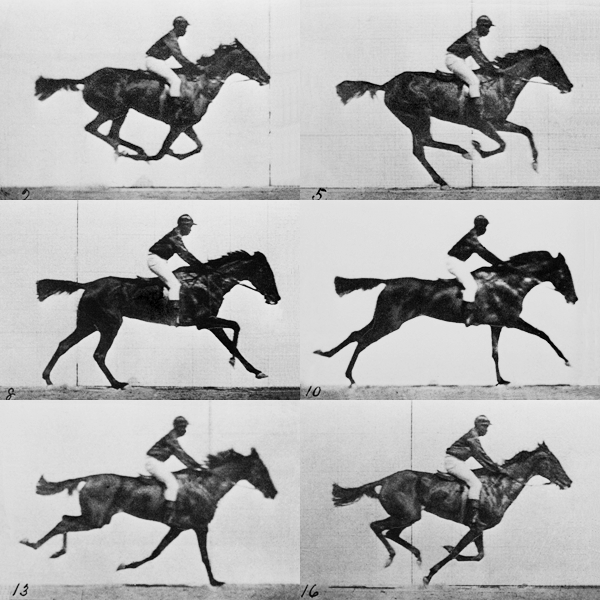
Most people have some awareness of the early history of moving pictures, the notion having been conceived almost as early as photography itself. Probably the first pioneer of the medium was the somewhat eccentric, but evidently brilliant, Edweard Muybridge. (He had changed his name – as he did several times – from the original Edward Muggeridge). Born in England, he lived for most of his life in the USA, where on his first visit he suffered a near-fatal blow on the head in a stagecoach accident. He recovered, but perhaps this accounted for some of the eccentricity. Some years later, in 1875, on he was tried, again in America, for murder, having shot dead his young wife’s lover. The defence entered a plea of insanity, but he rather gave the lie to that with a speech on his own behalf which was both cogent and impassioned enough to sway the jury to acquit him with a verdict of ‘justified homicide’.

Muybridge's horse

Muybridge’s horse (Wikimedia Commons)

Having started his career as a bookseller he later became a professional photographer, and in 1872 he was commissioned to settle a debate over whether all four hooves of a cantering or galloping horse were ever out of contact with the ground simultaneously. Having established by means of still photographs that they indeed were, he developed a fascination with the possibilities of capturing human and animal movement photographically. His earliest efforts, in the late 1870s, involved placing a number of cameras along the side of a track, and and using various mechanical methods to trigger them sequentially as a moving horse passed by them. Showing the result involved laboriously copying the photos as silhouettes on to a disc, from which they were projected using a device which Muybridge invented and called a Zoopraxiscope.  The animation above shows a modern rendering of his original images.

By the turn of the century integrated, hand-cranked film cameras had been developed, and so, like insects from their pupae, we see the people of over a hundred years ago emerge from their frozen monochrome images into a jerky, half-real life. And in retrospect it seems as if the lack of realism was accentuated as the medium began to be put to use for entertainment. There was already the Victorian tradition of high melodrama, and on top of this actors had to find ways of expressing themselves which did not use sound. The results now appear to us impossibly stilted and artificial.

Alongside this, however, entrepreneurs of the time had, luckily for us, spotted another opportunity to exploit the new medium. They realised that if they were to film ordinary people going about their business, those people may well pay a good price to be able to see themselves in an entirely novel way. And indeed they did. So we have a wonderful resource of animated scenes from streets and other public places of the era. Until recently these early examples of ciné verité haven’t been seen very often, and I’m guessing that the most important reason for this is that other limitation on realism – the speed of the original cameras. They were hand-cranked to the highest rate that the early mechanisms would allow, but this couldn’t match the frame rate of later twentieth century equipment. The choice has been either to slow it down and put up with jarringly jerky motion; or the easier way, of simply showing it at the conventional frame rate so that motion appeared much faster.  The latter option has been resorted to so often that it has given rise to a trope: accelerated motion equals the past. Even more contemporary footage showing mocked up scenes of an earlier era has sometimes been artificially speeded up, in order to borrow a little authenticity.

But with today’s digital techniques that is now changing. Not only can individual frames be cleaned up and clarified, but new frames can be interpolated into the instants between the original ones, slowing bodily movements and restoring a natural appearance. This new realism was what struck me about the scenes I saw of 1920s Germany – but we now have an increasing number of such enhanced early films, going back to around 1900, thanks to those original entrepreneurs. There are a number of examples on YouTube, so I have chosen one to insert here. It shows a selection of scenes in England around 1900. I like to pull the image up to full screen and immerse myself in it, imagining that I am walking the streets of late Victorian or early Edwardian England, and I try unsuccessfully to think the thoughts I might have been thinking if I had really been present then. Although these are humans like us, how do they differ?

Well, most obviously in their dress. What always takes my attention is the ubiquity of hats. I searched through this clip for anyone without one. There us one smartly dressed man standing at the back of a very well-heeled looking family group, who has perhaps just stepped out of the door behind him. Otherwise all I could find was one small child (who had probably lost his) and the rowers on the river and (who are stripped down to their sporting gear, with their hats probably safely awaiting them on pegs in the changing room). Evidently if I’d been alive then I would have considered it almost unthinkable to have left the house on even the shortest journey without something on my head – whether I was rich or poor. And even the rowers are followed by another group of men out for an afternoon boat trip, and they are fully hatted and suited as they brandish the oars. I was also taken by the man who appears about 40 seconds into the sequence, approaching the camera while, in an apparently habitual gesture, he strokes back each side of his carefully manicured handlebar moustache. His bearing suggests that he considers himself the epitome of 1900 cool. He unceremoniously sweeps two children out of his way before moving off to the left. That action in itself suggests that a rather less indulgent attitude to children was commonplace then.

But looking at urban streets at that time, and allowing for all the obvious differences, there still seems something unfamiliar about the movement of the crowd. I realised what it was when watching the 1920s German footage. At that time, in the inflation-hit Weimar Republic, the streets were full of half-starved unemployed, with little to do but – yes – watch the world go by. The film clip above shows people in a more prosperous time and place, but in most of the street shots you can nevertheless see a number who are just passively standing. Some of course are staring at the novelty of the film camera, but you can see plenty of others just watching in general.

Consider what entertainment was available: if you were to stay at home, and were not a reader (many of course never got the chance to be) you either had to make your own entertainment, or go out and find it. And so the street provided the most immediate – and cheapest – way to occupy the mind. In a typical street scene today, virtually everyone would be rushing somewhere unless forced into stasis by a wait for a bus, or by a queue of some sort. And even then they will often be busily talking on the phone or texting. While most of our 1900 public are also on the move, they have to make their way around that now-vanished residue of watchers who are happy to stand and stare at the rest of the world getting to where it wants to get to. And a visual medium in its very earliest form has given us a sense of what life was like without the visual media we are now so used to.

Accident of Birth

Commuting days until retirement: 390

My commuter train reading in recent weeks has been provided by Hilary Mantel’s two Mann Booker Prize-winning historical novels, Wolf Hall and Bring up the Bodies. If you don’t know, they are the first two of what is promised to be a trilogy covering the life of Thomas Cromwell, who rose to be Henry VIII’s right hand man. He’s a controversial figure in history: you may have seen Robert Bolt’s play (or the film of) A Man for All Seasons, where he is portrayed as King Henry’s evil arch-fixer, who engineers the execution of the man of the title, Sir Thomas More. He is also known to have had a big part in the downfall and death of Anne Boleyn.

The unique approach of Mantel’s account is to narrate exclusively from Cromwell’s own point of view. At the opening of the first book he is being violently assaulted by the drunken, irresponsible blacksmith father whom he subsequently escapes, seeking a fortune abroad as a very young man, and living on his very considerable wits. On his return to England, having gained wide experience and the command of several languages, he progresses quickly within the establishment, becoming a close advisor to Cardinal Wolsey, and later, of course, Henry VIII. I won’t create spoilers for the books by going into further detail – although if you are familiar with the relevant history you will already know some of these. I’ll just mention that in Mantel’s portrayal he emerges as phenomenally quick-witted, but loyal to those he serves. She shows him as an essentially unassuming man, well aware of his own abilities, and stoical whenever he suffers reverses or tragedies. These qualities give him a resilience which aids his rise to some of the highest offices in the England of his time. In the books we are privy to his dreams, and his relationships with his family – although he might appear to some as cold-blooded, he is also a man of natural feelings and passions.

Thomas Cromwell and the Duke of Norfolk

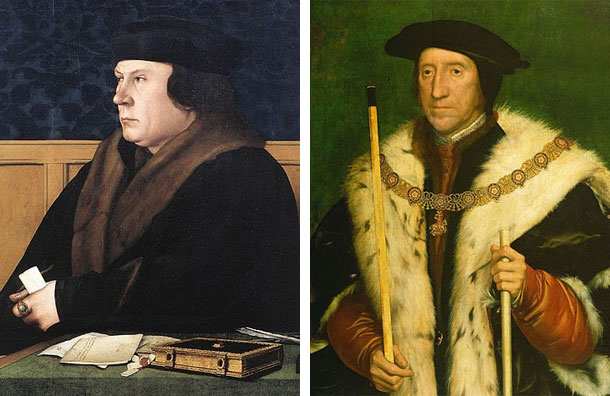
Thomas Cromwell (left) and Thomas Howard, Duke of Norfolk – both as portrayed by Hans Holbein

But the theme that kicked off my thoughts for this post was that of Cromwell’s humble origin. It’s necessarily central to the books, given that it was rare then for someone without nobility or inherited title to achieve the rank that he did. What Mantel brings out so well is the instinctive assumption that an individual’s value is entirely dependent on his or her inheritance – unquestioned in that time, as throughout most of history until the modern era. As the blacksmith’s son from Putney, Cromwell is belittled by his enemies and teased by his friends. But at the same time we watch him, with his realistic and perceptive awareness of his own position, often running rings around various blundering earls and dukes, and even subtly manipulating the thinking of the King. My illustrations show Cromwell himself and Thomas Howard, Duke of Norfolk, a jealous opponent. By all accounts Norfolk was a rather simple, plain-speaking man, and certainly without Cromwell’s intellectual gifts. So today we would perhaps see Cromwell as better qualified for the high office that both men held. But seen through 16th century eyes, Cromwell would be the anomaly, and Norfolk, with his royal lineage, the more natural holder of a seat in the Privy Council.

Throughout history there have of course been persistent outbreaks of protest from those disempowered by accident of birth. But the fundamental issues have often often obscured by the chaos and competition for privilege which result. We can most obviously point to the 18th century, with the convulsion of the French revolution, which resulted in few immediate benefits; and the foundation of a nation – America – on the ideals of equality and freedom, followed however by its enthusiastic maintenance of slavery for some years. Perhaps it wasn’t until the 19th century, and the steady, inexorable rise of the middle class, that fundamental change began. As this was happening, Darwin came along to ram home the point that any intrinsic superiority on the basis of your inheritance was illusory. Everyone’s origins were ultimately the same; what counted was how well adapted you were to the external conditions you were born into. But was this the same for human beings as for animals? The ability to thrive in the environment in which you found yourself was certainly a measure of utilitarian, or economic value. But is this the scale on which we should value humans? It’s a question that I’ll try to show there’s s still much confusion about today. Meanwhile Karl Marx was analysing human society in terms of class and mass movements, moving the emphasis away from the value of individuals – a perspective which had momentous consequences in the century to come.

But fundamental attitudes weren’t going to change quickly. In England the old class system was fairly steady on its feet until well into the 20th century. My own grandmother told me about the time that her father applied to enrol her brothers at a public school (i.e. a private school, if you’re not used to British terminology). This would have been, I estimate, between about 1905 and 1910. The headmaster of the school arrived at their house in a horse and trap to look the place over and assess their suitability. My great-grandfather had a large family, with a correspondingly large house, and all the servants one would then have had to keep the place running. He was a director of a successful wholesale grocery company – and hearing this, the headmaster politely explained that, being “in trade” he didn’t qualify as a father of sons who could be admitted. Had he been maybe a lawyer, or a clergyman, there would have been no problem.

Let’s move on fifty years or so, to the start of the TV age. It’s s very instructive to watch British television programmes from this era – or indeed films and newsreels. Presenters and commentators all have cut-glass accents that today, just 60 or so years on, appear to us impossibly affected and artificial. The working class don’t get much of a look in at all: in the large numbers of black-and-white B-movies that were turned out at this time the principal actors have the accents of the ruling class, while working class characters appear either as unprincipled gangster types, or as lovable ‘cheekie chappies’ showing proper deference to their masters.

By this time, staying with Britain, we had the 1944 Education Act, which had the laudable motive of making a suitable education available to all, regardless of birth. But how to determine what sort of education would be right for each child? We had the infamous eleven plus exam, where in a day or two of assessment the direction of your future would be set. While looking forward to a future of greater equality of opportunity, the conception seemed simultaneously mired in the class stratification of the past, where each child had a predetermined role and status, which no one, least of all the child himself or herself, could change. Of course this was a great step up for bright working class children who might otherwise have been neglected, and instead received a fitting education at grammar schools. Thomas Cromwell, in a different age, could have been the archetypal grammar school boy.

But given the rigid stratification of the system, it’s not surprising that within 20 years left wing administrations started to change things again. While the reforming Labour government of 1945-51 had many other things to concentrate on, the next one, achieving office in 1964, made education a priority, abolishing the 11 plus and introducing comprehensive schools. This established the framework which is only now starting to be seriously challenged by the policies of the current coalition government. Was the comprehensive project successful, and does it need challenging now? I’d argue that it does.

R A Butler

R A “Rab” Butler
(izquotes.com)

To return to basics, it seems to me that what’s at stake is, again, how you value an individual human being. In Cromwell’s time as we’ve seen, no one doubted that it was all to do with the status of your forbears. But by 1944 the ambitious middle class had long been a reality, showing that you could prove your value and rise to prosperity regardless of your origins. This was now a mass phenomenon, not confined to very unusual and lucky individuals, as it had been with Cromwell. And so education realigned itself around the new social structure. But with the education minister of the time, R.A. Butler, being a patrician (if liberal-minded) Tory, perhaps it was inevitable that something of the rigidity of the old class structure would be carried over into the new education system.

So if an exam at the age of eleven effectively determines your place in society, how are we now valuing human beings? It’s their intellectual ability, and their consequent economic value which is the determining factor. If you succeed you go to a grammar school to be primed for university, while if not, you may be given a condescending pat on the head and steered towards a less intellectually demanding trade. We would all agree that there is a more fundamental yardstick against which we measure individuals – an intrinsic, or moral value. We’d rate the honest low-achiever over the clever crook. But somehow the system, with its rigid and merciless classification, is sweeping the more important criterion aside.

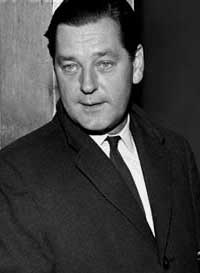
Anthony Crosland

Anthony Crosland
(stpancrasstory.org)

And so the reforming zeal of the 1960s Labour government was to remove those class-defining barriers and provide the same education for all. The education minister of that time was a noted intellectual – private school and Oxford educated – Anthony Crosland. His reported remark, supposedly made to his wife, serves to demonstrate the passion of the project: “If it’s the last thing I do, I’m going to destroy every fucking grammar school in England. And Wales and Northern Ireland”. (In Northern Ireland, it should be noted, he was less successful than elsewhere). But the remark also suggests a fixity of purpose which spread to the educational establishment for many years to come. If it was illegitimate to value children unequally, then in no circumstances should this be done.

You may or may not agree with me that the justified indignation of the time was leading to a fatal confusion between the two yardsticks I distinguished – the economic one and the moral one. And so, by the lights of Labour at that time, if we are allocating different resources to children according to their aptitudes – well, we shouldn’t. All must be equal. Yes – in the moral sense. But in the economic one? Even Karl Marx made that distinction – remember his famous slogan, “From each according to his ability, to each according to his need”?  All that the reformists needed to do, in my opinion, was to take the rigidity out of the system – to let anyone aspire to a new calling that he or she can achieve, at whatever age, and under whatever circumstances that their need arises.

Back to personal experience. I can remember when we were looking over primary schools for our first child – this would be in the early 90s. One particular headmaster bridled when my wife asked about provision for children of different abilities. The A-word was clearly not to be used. Yet as he talked on, there were several times that he visibly recognised that he himself was about to use it, spotted the elephant trap at the last moment, and awkwardly stepped around it. This confused man was in thrall to the educational establishment’s fixed, if unconscious, assumption that differing ability equals unequal value. (We didn’t send our children to that school.)

Over the years, these attitudes have led to a frequent refusal to make any provision for higher ability pupils, with the consequence that talent which might previously have been nurtured, has been ignored. If you can afford it, of course, you can buy your way out of the system and opt for a private education. Private school pupils have consistently had the lion’s share of places at the top universities, and so the architects and supporters of the state system ideology have called for the universities to be forced to admit more applicants from that system, and to restrict those from the private sector. Is this right? I’d argue that the solution to failure in the state schools is not to try and extend the same failed ideology to the universities, but to try to address what is wrong in the schools. A confusion between our economic and moral valuations of individual threatens to lead to consequences which are damaging, it seems to me, both in an economic and a moral sense.

The plans of the present UK education minister, Michael Gove, have come in for a lot of criticism. It would be outside the scope of this piece – and indeed my competence – to go into that in detail, but it does seem to me that he is making a principled and well intentioned attempt to restore the proper distinction between those economic and moral criteria – making good use of individual ability where it can be found, without being condescending to those who are not so academic, or making the distinctions between them too rigid. And of course I haven’t addressed the issue of whether the existence of a separate private education sector is desirable – again outside the scope of this post.

Martin Luther King

Martin Luther King
(Nobel Foundation)

What, at least, all now agree on is that the original criterion of individual value we looked at – birth status – is no longer relevant. Well, almost all. Racist ideologies, of course, persist in the old attitude. A recent anniversary has reminded us of one of the defining speeches of the 20th century, that of Martin Luther King, who laid bare the failure of the USA to uphold the principles of its constitution, and famously looked forward to a time when people would be “judged not by the color of their skin but by the content of their character”. The USA, whose segregationist policies in some states he was addressing, has certainly made progress since then. But beyond the issues I have described, there are many further problems around the distinction between moral and economic values. In most societies there are those whose contribution is valued far more in the moral sense than the economic one: nurses, teachers. What, if if anything, should we do about that? I don’t claim to know any easy answers.

I kicked off from the themes in Hilary Mantel’s books and embarked on a topic which I soon realised was a rather unmanageably vast one for a simple blog post. Along the way I have been deliberately contentious – please feel free to agree or disagree in the comments below. But what got me going was the way in which Mantel’s study of Cromwell takes us into the collective mind of an age when the instinctive ways of evaluating individuals were entirely different. What I don’t think anyone can reasonably disagree with is the importance of history in throwing the prejudices of our own age into a fresh and revealing perspective.

When I Set Out for Lyonnesse

Commuting days until retirement: 405

View from Tintagel Castle

The stuff of myths: our view from Tintagel Castle

Another week’s escape from commuting, as we visit a part of the Cornish coast I haven’t been to before – the northeast stretch around Tintagel and Boscastle. The cliff walks are breathtaking, there are magnificent deserted beaches accessible only after a steep scramble down rocky paths, and the area is stiff with historical and mythical associations.
Lyonnesse is the kingdom of legend where King Arthur supposedly held his court. In writings of the past there is much confusion about its location, but it has mainly been associated with Cornwall, and sometimes the Scilly Isles. Geoffrey of Monmouth, writing in the 12th century, names Tintagel as the place of Arthur’s conception. Along with many other sandalled, bare-legged tourists we clambered up the hill to the ruined medieval castle, and from the atmosphere and views began to appreciate why it’s a place that has generated legend.

A meeting

St Juliots

St Juliot’s church

But my title is borrowed from the poet and novelist Thomas Hardy. We had arrived at St Juliot’s, a small church outside Boscastle that we’d heard was worth visiting when I suddenly realised, having read Claire Tomalin’s excellent biography a year or two ago, that this was a highly significant place in Hardy’s life. It was here that, in 1870, as a young architectural assistant with dreams of being a writer, he had come to draw up plans for restoration to the church. Emma Gifford was the sister-in-law of the incumbent priest and was living in the rectory. We are told that she opened the door to him on his first arrival, and a piece of paper bearing a poem he’d been working on during the journey was sticking out of his pocket. This immediately attracted Emma. Love ensued, and he became a regular visitor to the rectory (a full day’s  journey from his native Dorset, Tomalin notes, involving four trains and a 16 mile ride in a trap).
The poem whose title I have borrowed celebrates that first trip – it’s short and jubilant in tone, and has him returning “with magic in my eyes”. Although not published until after Emma’s death, the manuscript is dated 1870, the time of the visit.

Rescued

Emma Gifford

Emma Gifford

Young Hardy

Thomas Hardy around the time he met Emma

They were married in London in 1874. With Hardy’s career as a novelist taking off, Emma was at first strongly appreciative and encouraging of his writing. It has been debated how far his early novel A Pair of Blue Eyes was autobiographical, and whether the character of the heroine Elfride Swancourt is based on Emma. While the setting is no doubt drawn from life – Elfride is the daughter of a parson living near the sea, and visited by admiring young men – the parallels are not otherwise close. But there is one surprising scene for the time, where on a coast walk, one of Elfride’s men friends slips on a cliff edge and is trapped, dangling dangerously. However, concealed by the clifftop, Elfride is enterprisingly removing her voluminous underwear and tearing it into strips to make a rope with which she rescues him. They embrace, but overcome with embarrassment at being naked beneath her dress, she flees home alone. Quite apart from the more obvious preoccupations of a young Victorian man, perhaps there is something symbolic of Hardy’s own fortunes here.

Later in life, when Hardy’s success as a novelist had become assured, however, Emma became more disenchanted with his writing. She had nursed some literary ambitions of her own, and perhaps there was an element of resentment. But relations became strained and distant in general, and she eventually retreated to an attic room in Max Gate, the Dorset house Hardy had built, and spent much of her time there.

Memorial plaque

Memorial to Emma

In 1912 she died suddenly, and Hardy, overcome with remorse and regret, seemed fall in love with her a second time, this time in retrospect. To the right is my photo of the memorial plaque to Emma he placed in the church. By all accounts Hardy was already close to Florence, his second wife, before Emma’s death, but his posthumous love affair with Emma persisted long afterwards, sometimes to Florence’s irritation.

An engraved window

Memorial window

A part of the memorial window to Thomas Hardy

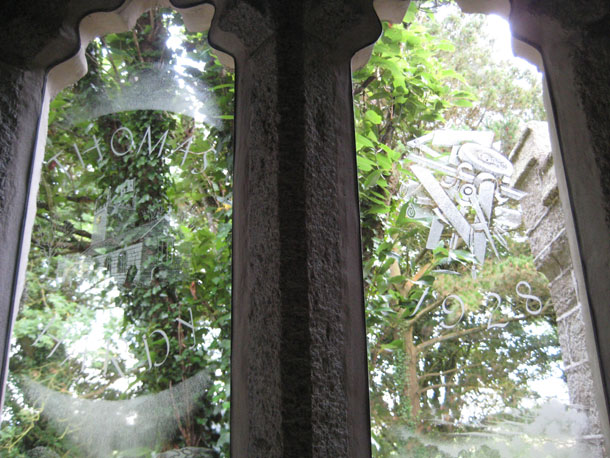
A few years ago a window was commissioned for the church, to commemorate Hardy’s association with it. Rather than being stained glass, the window is engraved, delicately and beautifully, by the late artist, Simon Whistler. I found it almost impossible to capture its quality in a photo; here is my best attempt, which just shows a part. You can see Hardy’s name in the centre pane, surrounding an image of the church  itself, and the date of his death on the right, under a representation of his architect’s tools. As you view the whole window, symbols and episodes from Hardy’s life shimmer against the backdrop of the graveyard outside, ghostly traces of the events of a century and a half ago.

The window also bears quotations from one or two poems inspired by his experiences in this part of Cornwall. In later life Hardy was independently wealthy from his novels, and after Emma’s death he turned to poetry in a way that he hadn’t before. In his collection Poems 1912-1913 he gives vent to his regret and hopeless longing. In a bottom corner of the memorial window are two lines from one of the most well known of them – Beeny Cliff. The window also depicts the figure of Emma on the cliff, astride her pony. Beeny Cliff itself is just a mile or so from the church, and some of our walks along the coastal path took us over it.

The poem made an impression on me when I first read it, before knowing anything about the context. If you are not keen on old fashioned romanticism, or a strong formal structure, then it’s probably not for you. But I have always had a soft spot for it: I like the way the emotion is powerfully conveyed by the insistent metre, and the poem contains many examples of the idiosyncratic but precise and evocative vocabulary often found in Hardy’s work. Here’s the whole poem:

Beeny Cliff

O the opal and the sapphire of that wandering western sea,
And the woman riding high above with bright hair flapping free –
The woman whom I loved so, and who loyally loved me.

The pale mews plained below us, and the waves seemed far away
In a nether sky, engrossed in saying their ceaseless babbling say,
As we laughed light-heartedly aloft on that clear-sunned March day.

A little cloud then cloaked us, and there flew an irised rain,
And the Atlantic dyed its levels with a dull misfeatured stain,
And then the sun burst out again, and purples prinked the main.

– Still in all its chasmal beauty bulks old Beeny to the sky,
And shall she and I not go there once again now March is nigh,
And the sweet things said in that March say anew there by and by?

What if still in chasmal beauty looms that wild weird western shore,
The woman now is – elsewhere – whom the ambling pony bore,
And nor knows nor cares for Beeny, and will laugh there nevermore.

View from Beeny Cliff

“That wandering western sea” as seen from Beeny Cliff

Consciousness 3 – The Adventures of a Naive Dualist

Commuting days until retirement: 408

A long gap since my last post: I can only plead lack of time and brain-space (or should I say mind-space?). Anyhow, here we go with Consciousness 3:

Coronation

A high point for English Christianity in the 50s: the Queen’s coronation. I can remember watching it on a relative’s TV at the age of 5

I think I must have been a schoolboy, perhaps just a teenager, when I was first aware that the society I had been born into supported two entirely different ways of looking at the world. Either you believed that the physical world around us, sticks, stones, fur, skin, bones – and of course brains – was all that existed; or you accepted one of the many varieties of belief which insisted that there was more to it than that. My mental world was formed within the comfortable surroundings of the good old Church of England, my mother and father being Christians by conviction and by social convention, respectively. The numinous existed in a cosy relationship with the powers-that-were, and parents confidently consigned their children’s dead pets to heaven, without there being quite such a Santa Claus feel to the assertion.

But, I discovered, it wasn’t hard to find the dissenting voices. The ‘melancholy long withdrawing roar’ of the ‘sea of faith’ which Matthew Arnold had complained about in the 19th century was still under way, if you listened out for it. Ever since Darwin, and generations of physicists from Newton onwards, the biological and physical worlds had appeared to get along fine without divine support; and even in my own limited world I was aware of plenty of instances of untimely deaths of innocent sufferers, which threw doubt on God’s reputedly infinite mercy.

John Robinson

John Robinson, Bishop of Woolwich (Church Times)

And then in the 1960s a brick was thrown into the calm pool of English Christianity by a certain John Robinson, the Bishop of Woolwich at the time. It was a book called Honest to God, which sparked a vigorous debate that is now largely forgotten. Drawing on the work of other radical theologians, and aware of the strong currents of atheism around him, Robinson argued for a new understanding of religion. He noted that our notion of God had moved on from the traditional old man in the sky to a more diffuse being who was ‘out there’, but considered that this was also unsatisfactory. Any God whom someone felt they had proved to be ‘out there’ “would merely be a further piece of existence, that might conceivably have not been there”. Rather, he says, we must approach from a different angle.

God is, by definition, ultimate reality. And one cannot argue whether ultimate reality exists.

My pencilled zig-zags in the margin of the book indicate that I felt there was something wrong with this at the time. Later, after studying some philosophy, I recognised it as a crude form of Anselm’s ontological argument for the existence of God, which is rather more elegant, but equally unsatisfactory. But, to be fair, this is perhaps missing the point a little. Robinson goes on to say that “one can only ask “what ultimate reality is like – whether it… is to be described in personal or impersonal categories.” His book proceeds to develop the notion of God as in some way identical with reality, rather than as a special part of it. One might cynically characterise this as a response to atheism of the form “if you can’t beat them, join them” – hence the indignation that the book stirred in religious circles.

Teenage reality

But, leaving aside the well worn blogging topic of the existence of God, there was the teenage me, still wondering about ‘ultimate reality’, and what on earth, for want of a better expression, that might be. Maybe the ‘personal’ nature of reality which Robinson espoused was a clue. I was a person, and being a person meant having thoughts, experiences – a self, or a subjective identity.  My experiences seemed to be something quite other from the objective world described by science – which, according to the ‘materialists’ of the time, was all that there was. What I was thinking of then was the topic of my previous post, Consciousness 2 – my qualia, although I didn’t know that word at the time. So yes, there were the things around us (including our own bodies and brains), our knowledge and understanding of which had been, and was, advancing at a great rate. But it seemed to me that no amount of knowledge of the mechanics of the world could ever explain these private, subjective experiences of mine (and I assumed, of others). I was always strongly motivated to believe that there was no limit to possible knowledge – however much we knew, there would always be more to understand. Materialsm, on the other hand, seemed to embody the idea of a theoretically finite limit to what could be known – a notion which gave me a sense of claustrophobia (of which more in a future post).

So I made my way about the world, thinking of my qualia as the armour to fend off the materialist assertion that physics was the whole story. I had something that was beyond their reach: I was a something of a young Cartesian, before I had learned about Descartes. It was a another few years before ‘consciousness’ became a legitimate topic of debate in philosophy and science. One commentator I have read dates this change to the appearance of Nagel’s paper What is it like to be a Bat in 1973, which I referred to in Consciousness 1. Seeing the debate emerging, I was tempted to preen myself with the horribly arrogant thought that the rest of the world had caught up with me.

The default position

Philosophers and scientists are still seeking to find ways of assimilating consciousness to physics: such physicalism, although coming in a variety of forms, is often spoken of as the default, orthodox position. But although my perspective has changed quite a lot over the years, my fundamental opposition to physicalism has not. I am still at heart the same naive dualist I was then. But I am not a dogmatic dualist – my instinct is to believe that some form of monism might ultimately be true, but beyond our present understanding. This consigns me into another much-derided category of philosophers – the so-called ‘mysterians’.

But I’d retaliate by pointing out that there is also a bit of a vacuum at the heart of the physicalist project. Thoughts and feelings, say its supporters, are just physical things or events, and we know what we mean by that, don’t we? But do we? We have always had the instinctive sense of what good old, solid matter is – but you don’t have to know any physics to realise there are problems with the notion. If something were truly solid it would entail that it was infinitely dense – so the notion of atomism, starting with the ancient Greeks, steadily took hold. But even then, atoms can’t be little solid balls, as they were once imagined – otherwise we are back with the same problem. In the 20th century, atomic physics confirmed this, and quantum theory came up with a whole zoo of particles whose behaviour entirely conflicted with our intuitive ideas gained from experience; and this is as you might expect, since we are dealing with phenomena which we could not, in principle, perceive as we perceive the things around us. So the question “What are these particles really like?” has no evident meaning. And, approaching the problem from another standpoint, where psychology joins hands with physics, it has become obvious that the world with which we are perceptually familiar is an elaborate fabrication constructed by our brains. To be sure, it appears to map on to the ‘real’ world in all sorts of ways, but has qualities (qualia?) which we supply ourselves.

Truth

So what true, demonstrable statements can be made about the nature of matter? We are left with the potently true findings – true in the the sense of explanatory and predictive power – of quantum physics. And, when you’ve peeled away all the imaginative analogies and metaphors, these can only be expressed mathematically. At this point, rather unexpectedly, I find myself handing the debate back to our friend John Robinson. In a 1963 article in The Observer newspaper, heralding the publication of Honest to God, he wrote:

Professor Herman Bondi, commenting in the BBC television programme, “The Cosmologists” on Sir James Jeans’s assertion that “God is a great mathematician”, stated quite correctly that what he should have said is “Mathematics is God”. Reality, in other words, can finally be reduced to mathematical formulae.

In case this makes Robinson sound even more heretical than he in fact was, I should note that he goes on to say that Christianity adds to this “the deeper reliability of an utterly personal love”. But I was rather gratified to find this referral to the concluding thoughts of my post by the writer I quoted at the beginning.

I’m not going to speculate any further into such unknown regions, or into religious belief, which isn’t my central topic. But I’d just like to finish with the hope that I have suggested that the ‘default position’ in current thinking about the mind is anything but natural or inevitable.

Psychogeography

Commuting days until retirement: 432

Psychogeography

Wikimedia Commons / Patrick J. Lynch. Adapted

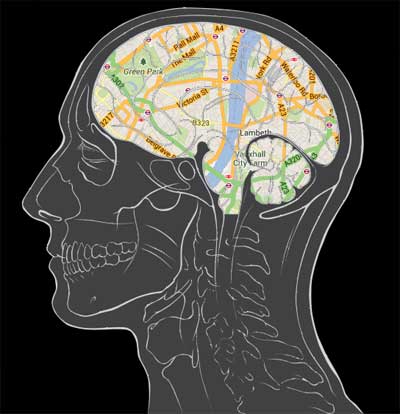
A break from philosophy, now, while we explore another discipline, one which I had not heard of before today – not under that name, anyway. I had the BBC’s Today programme on the car radio this morning, and there was an item about what it was like to live in an airport, with reference to the fugitive American whistleblower/spy, Edward Snowden. One of the participants in the piece was the writer Will Self, described as being a lecturer in psychogeography at Brunel University. This did get me listening more intently – I was intrigued as to what exactly he was teaching. It sounded like geography as taught by some of the teachers I remember from school. (To be fair, it was probably my lack of aptitude as a pupil that helped drive them to the brink of insanity.)

So the presenter started by asking, quite reasonably, “What is psychogeography?” Self’s reply was couched in such mind-numbing sociobabble that I was none the wiser. Instead I had to go to the BBC website later and find the recording, so that I could have another try. Here’s what he said:

Psychogeography is essentially the idea of purposeless transits across the urban context in order to deconstruct the commercial and political imperatives of contemporary space… [presenter: “Perfect”] …Well, yes, that’s it in a nutshell.

A rather hard nutshell to crack. Here’s my attempt at a translation:  A psychogeographer wanders about towns and cities, ignoring all the upfront messages and propaganda that the establishment would have you accept, and looks instead at what is really happening, in human terms. Maybe it’s rather like psychoanalysis: instead of accepting what the city tells you at face value, you delve into its messy, scatalogical subconscious. The difference, perhaps, between visiting an expensive restaurant and rummaging through its dustbins – you’d certainly learn a lot more of interest from the latter.

Here’s an alternative (in both senses of the word) definition, from Time Out magazines’s Bluffer’s Guide to Psychogeography.

A mélange of history, geography, pretension and psychology invented by ’50s Gallic eggheads, who described it thus: ‘The study of specific effects of the geographical environment, consciously organised or not, on the emotions and behaviour of individuals.’ Basically, it means making stuff up about London.

I suppose you can forgive Time Out for being a bit London-centric, even if the subject was invented by Frenchmen. The ever-helpful, ever-earnest Wikipedia fills this in a bit, tracing its roots in Dadaism and surrealism, and identifying a central figure in its development in the fifties as one Guy Debord. The article allows itself to quote his biographer thus:

This apparently serious term ‘psychogeography’ comprises an art of conversation and drunkenness, and everything leads us to believe that Debord excelled at both.

I begin to warm to the subject. And it does indeed seem from the Wikipedia article that much of the present day psychogeographical activity is centred on London: there are all the writings of Peter Ackroyd, and also a mention of Iain Sinclair makes me realise I have read him. His book London Orbital derives from a walk around the route of the M25, London’s orbital motorway, in which he explores life close to the ground, as it were, beneath the headline developments.

There are so many books in our house, so badly organised, that some of them disappear into the mélee and aren’t easily found again, and unfortunately that has happened to Sinclair. The same goes for what I remember as a very charming book in a similar vein, Christopher Ross’s Tunnel Visions: Journeys of an Underground Philosopher. The “Underground” is literal here – he took a job for a year and a half as a station assistant on the London Underground, where he studied, and entertainingly reported on, the oddities of human life in that environment.

However I have managed to unearth Leadville by Edward Platt, which does what Sinclair did for the M25 on the main road which leads westward out of London. And on my to-be-read pile is Edgelands by Michael Symmons Roberts and Paul Farley: two poets explore (in prose) those areas, largely created by commercial activity which are not quite urban, and not quite rural. A selection of chapter headings gives you the idea: Paths, Containers, Landfill, Sewage, Canals, Ruins, Mines, Airports, Piers. It strikes me that I have even dabbled in the area a little in this blog: see Memento Mori.

And perhaps psychogeography’s credentials as an academic subject are underscored by the sniping between its practitioners. I dipped into the Amazon preview of Self’s book, derived from a newspaper columns and simply entitled Psychogeography, but much of the contents didn’t seem terribly urban. And sure enough, in a Guardian Interview, Sinclair says:

For me, it’s a way of psychoanalysing the psychosis of the place in which I happen to live. I’m just exploiting it because I think it’s a canny way to write about London. Now it’s become the name of a column by Will Self, in which he seems to walk the South Downs with a pipe, which has got absolutely nothing to do with psychogeography. There’s this awful sense that you’ve created a monster.

But you don’t have to be a writer to be a psychogeographer. It so happens that last night we watched a TV programme about the French/American photographer Vivian Maier. Again new to me – in fact she was obscure and unknown throughout her life, which ended a few years ago. Working as a children’s nanny in New York and Chicago, she spent all the time she could wandering the streets with a camera, and amassed countless thousands of marvellous photographs, many of which remained undeveloped at her death. She was secretive and solitary, and although something of a hoarder, she never owned her own place of dwelling, and had nowhere to keep her archive. Instead she paid to keep it in storage throughout her life, and soon before her death it was sold off when the fees got into arrears. This was when it was discovered, and has since been split between various owners and become immensely valuable.

There’s no question that her pictures got under the skin of the urban landscape: favourite subjects include down-and-outs, or any faces whose mood and character come right out of the picture, including many children. Although a recluse with little social contact, she seemed to have the knack of getting close to her subjects, both physically and psychologically, despite her cumbersome Rolleiflex camera. Other subjects include landscapes, found abstract patterns or any objects or scenes which appealed to her eye. There is a whole series of self-portraits, always with a portentous, even disturbing feel to them.

The website for her work is here: http://www.vivianmaier.com. And the TV programme is on BBC iPlayer until early August.

Consciousness 2 – The Colour of Nothing

Commuting days until retirement: 437

When it comes down to basics, is there just one sort of thing, or are there two sorts of thing? (We won’t worry about the possibility of even more than that.) Anyone who has done an elementary course in philosophy will know that Descartes’ investigations led him to believe that there were two sorts: mental things and physical things, and that he thus gave birth to the modern conception of dualism.

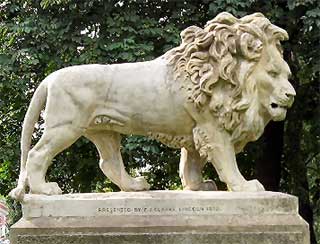
Stone lion

Lifeless

As scientific knowledge has progressed over the centuries since, it has put paid to all sorts of beliefs in mystical entities which were taken to be explanations for how things are. A good example would be vitalism, the belief in a ‘principle of life’  something that a real lion would possess and a stone lion would not. Needless to say, we now know that the real lion would have DNA, a respiratory system and so on, all of whose modes of operation we have much understanding – and so the principle of life has withered away, as surplus to needs.

Descartes mental world, however, has been harder to kill off. There seems nothing that scientific theory can grasp which is recognisable as the something it is like I discussed in my previous post. It’s rather like one of those last houses to go as Victorian terraces are cleared for a new development, with Descartes as the obstinate old tenant who stands on his rights and refuses to be rehoused. But the philosophical bulldozers are doing their best to help the builders of science, in making way for  their objectively regular modern blocks.

Gilbert Ryle led the charge in 1949, in his book The Concept of Mind. He famously characterised dualism as the doctrine of ‘the Ghost in the Machine’: to suppose that there was some mystical entity within us corresponding to our mind was to be misled by language into making a ‘category mistake’. Ryle’s standpoint fits more or less into the area of behaviourism, also previously discussed. Then, in the 1950s, identity theory arose. The contents of your mind  colors, smells  may seem different from from all that mushy stuff in your head and its workings, but in fact they are just the same thing, if perhaps seen from a different viewpoint. There’s a name, the ‘Morning Star’, for that bright star that can be seen at dawn, and another one, the ‘Evening Star’, for its equivalent at dusk; but with a little further knowledge you discover that they are one and the same.

Nowadays, while still around, the identity theory is somewhat mired in technical philosophical debate. Meanwhile brain science has made huge strides, and at the same time computing science has become mainstream. So on the one hand, it’s tempting to see the mind as the software of the brain (functionalism, very broadly), or perhaps just to attempt to show that with enough understanding of the wiring of those tightly packed nerve fibres, and whatever is chugging around them, everything can be explained. This last approach  materialism, or in its modern, science-aware form, physicalism  can take various forms, one of them being the identity theory. Or you may consider, for example, that such mental entities as beliefs, or pains, may be real enough, but are ideally explained as  or reduced to  brain/body functions. This would make you a reductionist.

But you may be more radical and simply say that these mental things don’t really exist at all: we are just kidded into thinking they do by our habitual way of talking about ourselves folk psychology, as it’s often referred to. Then you would be an eliminativist  and it’s the eliminativists I’d like to get my philosophical knife into here. Although I don’t agree with old Descartes on that much (I’ll expand in the next post), I have an certain affinity for him, and I’m willing to join him in his threatened, tumbledown house, looking out at the bulldozers ranged across the building site of 21st century Western philosophy.

Getting rid of qualia  or not

Acer leaves

My acer leaves

I think it would be fair to say that the arch-eliminativist is one Daniel Dennett, and it’s his treatment of qualia that I’d like to focus on. Qualia (singular quale) are those raw, subjective elements of which our sensory experience is composed (or as Dennett would have it, we imagine it to be composed): the vivid visual experience I’m having now of the delicately coloured acer leaves outside my window; or that smell when I burn the toast. I’m thinking of Dennett’s treatment of the topic to be found in his 1988 paper Quining Qualia, (QQ) and in Qualia Disqualified, Chapter 12 of his 1991 book Consciousness Explained (CE: with a great effort I refrain from commenting on the title). Now the task is to show that, when it comes to mental things, all that grey matter and its workings is all there is. But this is a problem, because when we look inside people’s skulls we don’t ever find the colour of acer leaves or the smell of burnt toast.

Dennett quotes an introductory book on brain science: ‘”Color” as such does not exist in the world: it exists only in the eye and brain of the beholder.’ But as he rightly points out, however good this book is on science, it has its philosophy very muddled. For one thing, the ‘eye and brain of the beholder’ are themselves part of the world – the world in which colour, we are told, does not exist. And eyes and brains have colours, too. But not like the acer leaves I’m looking at. There’s only one way to get to where Dennett wants to be: he has to strike out the qualia from the equation. They are really not there at all. That acer-colour quale I think I’m experiencing is non-existent. Really?

Argument 1: The beetle in the box

Maybe there is some help available to Dennett from one of the philosophical giants  Wittgenstein. Dennett calls it in, anyway, as support for the position that ‘the very idea of qualia is nonsense’ (CE, p.390). There is a famous passage in Wittgenstein’s Philosophical Investigations where he talks of our private sensations in an analogy:

Suppose everyone had a box with something in it: we call it a “beetle”. No one can look into anyone else’s box, and everyone says he knows what a beetle is only by looking at his beetle. Here it would be quite possible for everyone to have something different in his box … The thing in the box has no place in the language-game at all; not even as a something: for the box might even be empty. No, one can ‘divide through’ by the thing in the box; it cancels out, whatever it is.

I don’t see how this does help Dennett. It is part of Wittgenstein’s exposition known as the private language argument. He is seeking to show that language is a necessarily public activity, and that the notion of a private language known only to its one ‘speaker’ is incoherent. I think it’s significant that the example of a sensation he uses is pain, as you’ll see if you follow the link. Elsewhere Wittgenstein considers whether someone might have a private word for one of his own sensations. But, like the pain, this is just a sensation, and there’s no publicly viewable aspect to it.   But consider my acer leaves: my wife might come and join me in admiring them. We have a publicly available referent for our discussion, and if I ask her about the quality of her own sensation of the colour, she will give every appearance of knowing what I am talking about. True, I can never tell if her sensation is the same as mine, or whether it even makes sense to ask that. Nor can I tell for certain whether she really has the sensation, or is simply behaving as if she did. But I’ll leave that to Wittgenstein. His argument doesn’t seek to deny that I am acquainted with my ‘beetle’  only that it ‘has no place in the language game’. In other words, my wife and I can discuss the acer leaves and what we think of them, but we can’t discuss the precise nature of the sensation they give me – my quale. My wife would have nothing to refer to when speaking of it. In Wittgenstein’s terms, we talk about the leaves and their colour, but our intrinsically private sensations drop out of the discussion. Does this mean the qualia don’t exist? Just a moment I’ll have another look… no, mine do, anyway. Sorry, Dan.

Argument 2: Grown-up drinking

Bottled Qualia

Bottled Qualia

Another strategy open to Dennett is to point out how our supposed qualia may seem unstable in certain ways, and subject to change. He notes how beer is an acquired taste, seeming pretty unpleasant to a child, who may well take it up with gusto later in life. Can the adult be having the same qualia as the child, if the response is so different?

This strikes a chord with me. I started to sample whisky when still a teenager because it made me feel mature and sophisticated. Never mind the fact that it was disgusting  much more important to pretend to be the sort of person I wanted to be. The odd thing is  and I have often wondered about this  that I think I can remember the moment of realisation that eventually came: “Hey  I actually like this stuff!”

So what happened? Did something about these particular qualia suddenly change, rather as if I one day licked a bar of soap and found that it tasted of strawberries? Clearly not. So maybe we could say, that, although it tasted the same, it was just that I started to react to it in a different way  some neural pathway opened up in my brain that engendered a different response. There are difficulties with that idea. As Dennett puts it, in QQ:

For if it is admitted that one’s attitudes towards, or reactions to, experiences are in any way and in any degree constitutive of their experiential qualities, so that a change in reactivity amounts to or guarantees a change in the property, then those properties, those “qualitative or phenomenal features,” cease to be “intrinsic” properties, and in fact become paradigmatically extrinsic, relational properties.

He’s saying, and I agree,  that we can’t mix up subjective and objective properties in this way, otherwise the subjective elements – the qualia – are dragged off their pedestal of private ineffability and are rendered into ordinary, objectively viewable, ones. He goes on to argue, with other examples, that the concept of qualia inevitably leads to confusions of this sort, and that we can therefore banish the confusion by banishing the qualia.

So is there another way out of the dilemma, which rescues them? As with the acer leaves, my whisky-taste qualia are incontrovertibly there. Consider another type of subjective experience  everyone probably remembers something similar. You have been working, maybe in an office, for an hour or two, and suddenly an air conditioning fan is turned off. It was a fairly innocuous noise, and although it was there you simply weren’t aware of it. But now that it’s gone, you’re aware that it’s gone. As you may know, the objective, scientific term for this is ‘habituation’; your system ceases to respond to a constant stimulus. But this time I am not going to make the mistake of mixing this objective description with the subjective one. A habituated stimulus is simply removed from consciousness  your subjective qualia do change as it fades. And something like this, I would argue, is what was happening with the whisky. To a mature palate, it has a complex flavour, or to put it another way, all sorts of different, pleasurable individual qualia which can be distinguished. These put the first, primary, sharp ‘kick’ in the flavour into a new context. But probably that kick is all that the immature version of myself was experiencing. Gradually, my qualia did change as I habituated sufficiently to that kick to allow it to recede a little and allow in the other elements. There had to come some point at which I made up my mind that the stuff was worth drinking for its own sake, and not just as a means to enhance my social status.

Argument 3: Torn cardboard

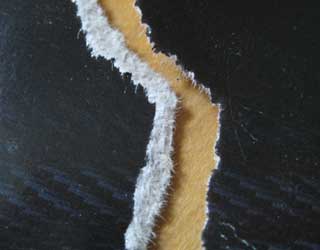
Torn cardboard

Matching halves

Not convinced? Let’s look at another argument. This starts with an unexpected – and ingenious  analogy: the Rosenbergs, Soviet spies in the US in the cold war era, had a system to enable to spies to verify one another’s identity: each had a fragment of cardboard packaging, originally torn halves of the same jelly package (US brand name Jell-O). So the jagged tear in each piece would perfectly and uniquely match the other. Dennett is equating our perceptual apparatus with one of the cardboard halves; and the characteristics of the world perceived with the other. The two have co-evolved. Anatomical investigation shows how birds and bees, whose nourishment depends on the recognition of flowers and berries, have colour perception, while primarily carnivorous animals  dogs and cats for example  do not. But at the same time plants have evolved flower and berry colour to enable pollination or seed dispersal by the bees or birds. The two sides evolve, matching each other perfectly, like the cardboard fragments. And of course we are omnivores, and have colour perception too. When hunting was scarce, our ability to recognise the colour of a ripe apple could have been a life-and-death matter. And so it would have been for the apple species too, as we unwittingly propagated its seeds. As he puts it:

Why is the sky blue? Because apples are red and grapes are purple, not the other way around. (CE p378)

A lovely idea, but what’s the relevance? His deeper intention with the torn cardboard analogy is to focus on the fact that, if we look at just one of the halves on its own, we are hard put to see anything but a piece of rubbish without purpose or significance  it is given validity only by its sibling. Dennett seeks to demote colour experiences, considered on their own, to a similarly nullified status. Here’s a crucial passage. ‘Otto’ is Dennett’s imaginary defender of qualia  for present purposes he’s me:

And Otto can’t say anything more about the property he calls pink than “It’s this!” (taking himself to be pointing “inside” at a private, phenomenal property of his experience). All that move accomplishes (at best) is to point to his own idiosyncratic color-discrimination state, a move that is parallel to holding up a piece of Jell-O box and saying that it detects this shape property. Otto points to his discrimination-device, perhaps, but not to any quale that is exuded by it, or worn by it, or rendered by it, when it does its work. There are no such things. (CE p383 – my italics).

I don’t think Dennett earns the right to arrive at his concluding statement. There seem to me to be two elements at work here. One is an appeal to the Wittgensteinian beetle argument we considered (‘…taking himself to be pointing “inside”…’), which I tried to show does not do Dennett’s work for him. The second appears to be simply a circular argument: if we decide to assert that Otto is not referring any private experience but something objective (a ‘color-discrimination state’) then we have only banished his qualia by virtue of this assertion. The fact that we can’t be aware of them for ourselves does not change this. The function of the cardboard fragment is an objective one, inseparable from its identification of its counterpart, just as colour perception as an objective function is inseparable from how it evolved. But there’s nothing about the cardboard that corresponds to subjective qualia  the analogy fails. When I think of my experience of the acer leaves I am not thinking of the ‘color-discrimination state’ of my brain  I don’t know anything about that. In fact it’s only from the science I have been taught that I know that there is any such thing. (This final notion nods to another well-known argument – this time in favour of qualia – Frank Jackson’s ‘knowledge’ argument  I’ll leave you to follow the link if you’re interested.)

But this being just a blog, and this post having already been delayed too long, I’ll content myself with having commented on just three arguments from one physicalist philosopher. And so I am still there with Descartes in his tottering house, resisting its demolition. In the next post I’ll enlarge on why I am so foolhardy and perverse.

Consciousness 1 – Zombies

Commuting days until retirement: 451

Commuting at this time of year, with the lengthening mornings and evenings, gives me a chance to lose myself in the sight of tracts of England sliding across my field of vision – I think of Philip Larkin in The Whitsun Weddings:  ‘An Odeon went past, a cooling tower, and someone running up to bowl…’  (His lines tend to jump into my mind like this). It’s tempting to enlarge a scene like this into a simile for life, like the one that Larkin’s poem leads into. Of course we are not just passive observers, but the notion of life as a film show – a series of scenes progressing past your eyes – has a certain curious attractiveness.

A rather more specatcular view than any I get on my train journey. Photo: Yamaguchi Yoshiaki. Wikimedia Commons

A rather more specatcular view than any I get on my train journey.
Photo: Yamaguchi Yoshiaki. Wikimedia Commons

Now imagine that, as I sit in the train, I am not quite a human being as you think of one. Instead I’m a cleverly constructed robot who appears in every way like a human but, being a robot, has something important missing. The objects outside the train form images on some sensor in each of my pseudo-eyes, and the results may then be processed by successive layers of digital circuitry which perform ever more sophisticated interpretative functions. Perhaps these resolve the light patterns that entered my ‘eyes’ into discrete objects, and and trigger motor functions which cause my head and eyes to swivel and follow them as they pass. Much, in fact, like the real me, idly watching the scenes sliding by.

Now let’s elaborate our robot to have capabilities beyond sitting on a train and following the objects outside; now it can produce all the behaviour that any human being can.This curious offspring of a thought-experiment is what philosophers refer to as a zombie – not the sort in horror films with the disintegrating face and staring eyeballs, but a creature who may be as well behaved and courteous as any decent human being. The only difference is that, despite (we presume) the brain churning away as busily as anyone else’s, there are no actual sensations in there – none of those primary, immediate experiences with a subjective quality: the fresh green of a spring day, or the inner rapture of an orgasm. So what’s different? There are a number of possibilities, but, as you will have guessed, the one I am thinking of is that inner, subjective world of experience we all have, but assume that machines do not. This is well expressed by saying that there’s something that it is like to be me, but not something that it’s like to be a machine.(1)  The behaviour is there all right, but that’s all. In the phrase I rather like, the lights are on but nobody’s at home.

Many people who think about the question nowadays, especially those of a scientific bent, tend to conclude that, of course, we must ultimately be nothing but machines of one sort or another. We have discovered many – perhaps most – of the physical principles upon which our brains and bodies work, and we have traced their evolution over time from simple molecular entities. So there we are – machines. But conscious machines – machines that there is something it is like to be? It has frequently been debated whether or not such a machine with all these capabilities would ipso facto be conscious – whether it would have a mind. Or, in other words, whether we could in principle build a conscious machine. (There are some who speculate that we may already have done so.)

One philosophical response to this problem is that of behaviourism, a now justly neglected philosophical position.(2) If you are a behaviourist you believe that your mind, and your mental activity – your thoughts – are defined in terms of your behaviour. The well-known Turing Test constitutes a behaviourist criterion, since it is based on the principle that a computer system whose responses are indistinguishable from those of a human is taken for all practical purposes to have a mind. (I wrote about Turing a little while ago – but here I part company with him.) And for a behaviourist, the phrase ‘What it is like to be…’ can have no meaning, or at best a rather convoluted one based on what we say or do; but its meaning is plain and obvious to you or me. It’s difficult to resist repeating the old joke about behaviourism: two post-coital behaviourists lie in bed together, and one says ‘That was great for you – how was it for me?’ But I take the view of behaviourism that the joke implies – it’s absurd.

Behaviourists, however, can’t be put down as burglars or voyeurs: they don’t peer into the lighted windows to see what’s going on inside. It’s enough for them that the lights are on. For them the concept of a zombie is either meaningless or a logical impossibility.  But there is another position on the nature of the mind which is much more popular in contemporary thought, but which has a different sort of problem with the notion of a zombie. I’m thinking of eliminative materialism.

Well, as I write this post, I feel it extending indefinitely as more ideas churn through that machine I refer to as my brain. So to avoid it becoming impossibly long, and taking another three weeks to write it, I’ll stop there, and just entitle this piece as Part 1. Part 2 will take up the topic of eliminative materialism.

In the meantime I’d just like to leave one thought: I started with a snatch of Philip Larkin, and I’ve always felt that poetry is in essence a celebration of conscious experience; without consciousness I don’t believe that poetry would be possible.


(1) The phrase is mainly associated with Thomas Nagel, and his influential 1974 paper What is it Like to be a Bat? But he in turn attributes it to the English philosopher Timothy Sprigge.

(2) I’m referring to the philosophical doctrine of behaviourism – distinct from, but related to the psychological one – J B Watson, B F Skinner et al.

Venice and the Hand of God

Commuting days until retirement: 460

Venice02It’s now two weeks since the Venice visit I mentioned last time, and I haven’t had sufficient reflection time to conjure up a blog about it, or about anything else for that matter. But looking at some of my photos has brought it back to mind – so here we go.

Venice06It has been the first time my wife and I have gone there together, if we discount an impossibly hot day spent there 12 years ago with the children, who then still were children. This time, among the beautiful, ancient architecture and the rampant tourism, it struck me how there is nowhere else I know that history mixes so intimately with brash modernity. Everywhere you are surrounded by the fading grandeur that Italy does so much better than anywhere else. Like a party of very elderly ladies on Blackpool beach, the clustered buildings wrap their gothic dignity about them, persisting serenely among the seething bees’ nest of tourist activity that has its focus in the scrum of St Mark’s Square.

We approach the square on a warm day over a crowded canal bridge, and as we climb the steps we are buffeted by our fellow tourists’ backpacks and factor 10 smeared elbows. Just as Venice05we reach the top, the Bridge of Sighs comes into view, and there’s a frenzy of digitally simulated shutter clicks. On we go, and brave the queue to get into the Doge’s Palace, then being rewarded with its gorgeous art and architecture. We pass under Tintoretto’s spectacular battle scenes, and before leaving walk through a long succession of halls filled with vicious medieval weapons of war. They shift your perception from Venice as a graceful old lady, to appreciating it as a city state jealously guarding its position in the rivalry and commercialism of the middle ages.

On, and out into the warren of alleyways among the buildings packed between the canals. Muscular men scurry around the strolling tee-shirted and camera-clad visitors, dragging laden trolleys of goods to restock the tourist shops. The background sound is of the canal water slapping against the mildewed brickwork, where pink stuccoed gothic descends into its muddy, hidden foundations. We take a vaporetto to see the city from the water, and my first, uninspired photo from the boat turns out to have an addition I don’t notice when I took it:

Venice04It adds something to what would have been an unoriginal image – the hand of God? Well if  so, it’s conspicuously absent thereafter. One day and a few mosquito bites later, we set out for some of the outer islands. On Murano there are the glassblowers, nonchalantly practising their lifetime, unfathomable skills in front of us gawping tourists.

Burano1And then Burano, where we are struck by the leaning church tower, which I hadn’t known about. Well, the hand of God has had hundreds of years to do something about that – but no luck.

This island is known for its colourful houses – apparently if you want to paint your house here you have to apply to the local authority, which will graciously assign you a colour. We spent some time wondering whether the washing hung out at the front (very Italian) was deliberately colour co-ordinated with each house.

Burano2Next stop, just opposite Burano, is the peaceful, rural island of Torcello – seeming particularly quiet and pastoral after Venice itself. My only pious intention of our visit was to go to the church of Santa Maria del Assunta, one of Europe’s oldest. It boasts spectacular 11th century mosaics over the altar. I was lucky enough to see these, nearly 30 years ago, on a work trip, and wanted to refresh my memory. We realised the time had got to 5.45, and our guide book said it was open until 6. But the sign when we got there, in English: Last entry 5.30. We tracked down the man in charge, but he was adamant. No go. So the hand of God was not willing to make another appearance on our behalf.

Ah well – next time, perhaps – if He grants me another 30 years.