Fate – Grim or Otherwise

Commuting days until retirement: 469

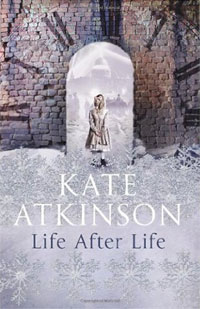
life-after-lifeThe existence of each one of us, and the crucial events of our lives, are entirely dependent upon a chain of often minor and unrecorded preceding circumstances. Yes – a rather pompous-sounding and trivial observation, but when seen from a subjective point of view it can seem to assume a more profound significance. What prompts this is the novel I’ve just finished, Kate Atkinson’s Life After Life.

It’s a theme that often surfaces in contemporary fiction: in Making it Up Penelope Lively takes the events of her own life and allows them to develop in plausible directions other than the one in which they actually did; David Mitchell (the novelist, not the TV personality), in his first novel Ghostwritten, traces interlinked chains of causality around the globe in which, giving just one example, a fleeting encounter in a London street has critical consequences for the future of humanity.

Kate Atkinson has been a favourite of mine since her first novel, Behind the Scenes at the Museum. She has a Dickensian ability to create an extensive collection of characters each of whom are entirely convincing, and whose interactions with each other may surprise you, but are never less than believable. In fact I find her characters more realistic, and less caricatured, than those of Dickens.

In Life After Life her realism becomes a little more magical. It concerns Ursula Todd, born in 1910 and witnessing the events of the 20th century in a variety of different ways (or not at all) as repeated versions of her life take different courses. I’m not giving anything much away – as both of these events come at the very beginning of the book – if I tell you that in one life she dies at birth, and in another gets to assassinate Hitler before he becomes Chancellor of Germany. Ursula’s large and believable family (Atkinson is particularly good at families) also individually suffer a variety of fates alongside Ursula’s own. The close juxtaposition of earthy reality and fanciful metaphysics comes off, for me, entirely successfully.

So what about the metaphysics of real life? Just to consider this blog, it owes its existence to a whole host of preceding factors. Among them is Sir Tim Berners-Lee, as is the precise trajectory of a shell in the battle of the Somme in 1916, which, had it been very slightly different, would have resulted in the death of my grandfather. As it was, it landed close enough to him to give him what all WW1 soldiers hoped for – a ‘Blighty wound’, which was a passport back home.

A scene at Pozieres during the Battle of the Somme

A scene at Pozières during the Battle of the Somme

Torquay in the early 20th century

Torquay in the early 20th century

But the first my grandfather knew of it was when he came back to consciousness in a hospital in Torquay. Like most who have been through experiences like his, he never said very much about them. However some measure of what he had been through lies in the fact that he felt moved to return to Torquay for a holiday nearly every year for the rest of his life. His son, who would have been my uncle, was not so lucky, though. He lost his life in the first months of the second world war at the age of 19. I was told how likeable and outgoing he was as a character, and I’m sure he would have gone on to have a family. I sometimes spare a thought for my non-existent cousins.

Photo: Steve Cadman

Photo: Steve Cadman

Most of us are aware of certain fateful moments in our own lives – at any rate in retrospect. The one that often returns to me took place when I was on a work trip to New York. My hotel room had a view over the United Nations, giving me an almost cheesily memorable backdrop for my thoughts as I sat there. And my thoughts were about a woman of my acquaintance, and how a postcard suggesting we should go out together would be received, if I sent it to her.

The indecision finally resolved itself, and I sent the card. It gives me a curious, vertiginous feeling to think that the existence of my very real, and now adult, children hung in the balance at that moment. You may wonder what their reaction would be on reading this. It would be Oh God, not that story again.

Well, my nearly-wasn’t wife and I are shortly off to Venice for a long weekend. The idea is to have a relaxing break, but having just run the gauntlet of the Ryanair online check-in process we are starting to wonder. Anyhow, I don’t expect to encounter any life-changing events there; but if I return with any memories worth mentioning they may find their way on to these pages.

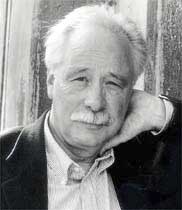
W G Sebald

Commuting days until retirement: 477

WGSebaldIt’s a rather sad experience to discover a contemporary writer who immediately engages you, only to learn that he has recently died – so that once you have exhausted his published novels there will be no more. This was my experience in the case of W G Sebald.

Sebald was a German writer, an immensely intelligent and learned man, who had learned early in life of his family’s former involvement in Nazi regime activity. He preferred to become an expatriate, studying in Manchester and taking up an academic post there. He then lived in Switzerland for a short time before returning to England to become a lecturer, and then Professor of European Literature at the University of East Anglia. He held this post at the time of his death in a car crash in Norfolk in late 2001. He had evidently suffered a heart attack at the wheel.

austerlitzAs far as I remember I came across him simply by picking up one of his books in a shop. At first sight I wasn’t sure what to make of it, but it seemed so different from anything else I had come across that I had to buy it. The book was Austerlitz, his last published novel. Embarking on a Sebald novel takes you into an unfamiliar but compelling experience, where you are never quite sure what is entirely fictional and what is reference to factual reality. This ambiguity is enhanced by the grainy black and white photos, engravings and other visuals which punctuate the text, appearing to depict real things but at the same time conjuring up a dream-like atmosphere. The basic narration is always first person, but it’s never quite clear to what extent the persona is Sebald’s own. This effect is further enhanced in Austerlitz, as most of the story is spoken by the eponymous character, but told to the first person narrator who meets and talks with him in a variety of settings across Europe.

Sebald’s prose style is also unique. Sentences will generally be long, punctuated with commas, and in the course of a single sentence he will often digress from the here-and-now, maybe to refer to some historical fact, or describe the foibles of some character, before returning to the present. A Sebald novel is an other-worldly experience, both real and not-real, and makes reading him (for me, anyway) uniquely pleasurable. I don’t often re-read novels, conscious of everything out there which I have yet to read and probably never will – but Sebald is an exception to this. As is shown by the interview I have included below, the texture of his work is laden with allusions and metaphors, few of which I have been aware of on a first reading. He writes in German, and is translated, but he was generally closely involved in the translations himself, so we can be sure of their authenticity. I would recommend all four of his novels: The Emigrants, Vertigo, The Rings of Saturn, and Austerlitz.

My post was prompted by a piece in this weekend’s Guardian Review, where I was pleased to find that a new book of his essays is being published next month. (There are other books of essays and poetry that I have not yet read – I’m saving them up for myself.) One of the essays is reprinted there: if I had read just the first sentences without knowing who the author was, I would immediately have recognised him as Sebald.

He was, according to all accounts, a shy, modest and delightful man. He was known univerally to those who knew him as ‘Max’. A couple of years ago I was lucky enough to meet someone who had been a friend of his – the Hungarian-born poet George Szirtes, a fellow member of staff at the Univerity of East Anglia. I learned how well liked he was, and what enormous sadness friends felt when he died.

Looking around the internet, I found a YouTube interview with an American radio station, made just before his death, so I have embedded it here.

Memento Mori

Commuting days until retirement: 477

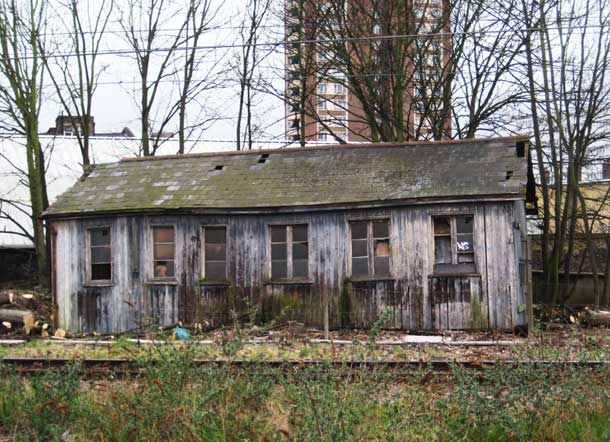
After my stay in what is officially an Area of Outstanding Natural Beauty, here’s some beauty of a less conventional kind. I glimpsed it out of the train window, and it stayed in my thoughts, and maybe dreams, for a few days afterwards. Since it’s right by a station I was able to return and photograph it.

broken shed
At this point I wondered whether I should simply leave it there for you to enjoy (or not), but since writing is what this blog is really about, I’m going to go ahead and write about it.

What this perfectly exemplifies for me is all those abandoned and forgotten enclaves of wilderness that are constantly close to us, especially in an urban environment. Many of them seem to be created by the presence of railway lines, which carve out little squares and triangles of unusable, inaccessible land which grow weeds and irresistibly attract plastic bottles, tin cans and all the detritus of the surrounding activity. Activity that’s hard to escape from if you need to earn a living, serving a multiplicity of ephemeral but urgent needs. (I’m sounding like an Church of England sermon.)  I wanted to say that forgotten outposts like this pictured one, by contrast, lie outside the frantic zone, and just are. This example is just by the main line where hundreds of thousands of commuters pass daily with their laptops, iPads, dry cleaned suits and power hair styles. Some of them, like me, must give it their attention as they stare out of the window.

I like the way that it immediately changes the perspective that my mind is locked into much of the time. The effect is like one of those stark portraits of an elderly person on the fringes of life, usually from a third world setting, that you often see in the work of a professional photographer. You are struck by the deep wrinkles, the inscrutable expression and the steady gaze. Here it’s the thoroughly wrecked appearance, as well as the utter unregarded dereliction, that invokes some obscure emotional response. Dirt and decay. How did it come to suffer not only broken windows and a holed roof, but also a total structural dislocation, as if picked up and thrown down by a giant hand? It seems to mock the vertical regularity of the flats visible behind it.

It has itself been regular, designed artefact, originally formed out of the surrounding chaos only to be irresistibly drawn back into it – and I think that’s the morbid attraction of a sight like this. For the purposeful, dressed and coiffured commuters who pass by daily it’s a reminder of the disorder and death on the fringes of their assiduously chased aspirations. I’m reminded of the famously death-averse (and dead) poet Philip Larkin, and his poem titled with a jaunty irony Next Please. He characterises our hopes and ambitions:

Watching from a bluff the tiny, clear
Sparkling armada of promises draw near.

But concludes

Only one ship is seeking us, a black-
Sailed unfamiliar, towing at her back
A huge and birdless silence.

Too much to read into a picture of an old shed? If I have made anyone unnecessarily gloomy I apologise. Perhaps blogs should carry warnings, like films or TV programmes: This post contains thoughts that some readers may find depressing. But I like a good wallow.

It’s commuting, but not as we know it

Commuting days until retirement: 487

No commuting this week: we are spending our Easter holiday, as we have for several years now, on Scilly, a group of islands 30 miles off the coast of south west England. And this break in the usual rhythm of my life is a chance to – among other things – think about the differing rhythms of some other lives. I believe the island where we are staying, Bryher, is the smallest inhabited one of the group – it has a permanent population of about 80, added to seasonally by people like us.

Imagine an island about two miles long, with the mildest climate in the British Isles. Its south-eastern end, sheltered, with palm trees and colourful flowers, has an almost tropical feel (Green Bay), while its north-eastern extremity consists of moorland covered in heather and ending in cliffs facing out into the Atlantic storms (Hell Bay). To live here is to be permanently surrounded by exceptionally beautiful, almost deserted, scenery. In order to enjoy this you’d have to accept being cut off from the mainland – in the sense that it requires an expensive boat or plane trip to get there. You have phone, TV/radio and the internet, of course (eagerly adopted by these islands when it arrived), but work here mostly consists of farming or servicing the tourist trade – in other words a lot of tough manual labour.

But there are other blessings: almost no motorised transport, apart from tractors, quad bikes and a few Land Rovers, and a complete absence of crime. Nobody locks their doors, and if you’ve ordered food from the shop it may be delivered while you’re out, neatly put away in your kitchen or fridge. It’s perfect for idle holidaymakers like us: there’s a hotel, two other restaurants, a well-stocked shop and, as of this year we discover, even a pizza takeaway open two evenings a week.

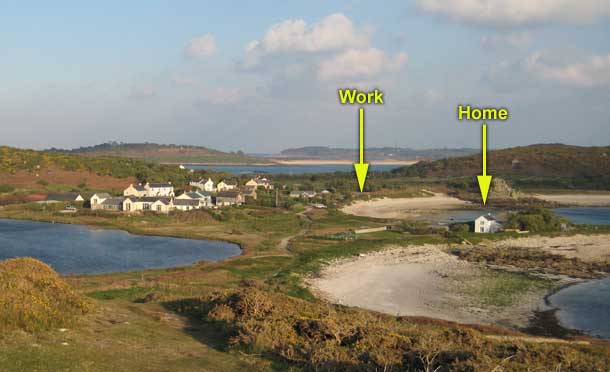
Scilly-commute0Commuting, where it exists, is of course something completely different – maybe by boat, between islands. Young children here commute to school by a short boat trip to the next island, and older ones board weekly at a secondary school on the largest island. But here’s a commute which I rate as the most desirable I have ever come across. There’s an artist who works on the island, and has what seems to be a good living. Paintings in his recognisable style appear in hotels and other settings around the islands as well as the nearby mainland. The island hotel has adopted a detail from one of his paintings as its logo, and he sells prints and merchandise to many of us tourists. In the picture below you can see where he lives and where he works. This is a commute that I could put up with indefinitely.

Scilly-commute2

Right Now

Commuting days until retirement: 491

Right now I am at home – another day off – waiting for some gravel to be delivered for our front drive. Right now, you are reading this (well I hope somebody is, or will). You can see I am having trouble with tenses here, because your ‘now’ is not my ‘now’. I know you are not reading this now, because I haven’t published it. But you know you are reading it now.

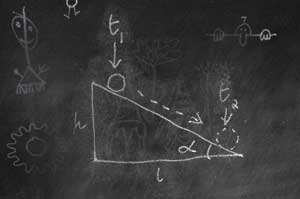
BlackboardThis all might seem a bit trivial and pointless, but stay with me for a bit. The notion I am circling around is the curious status of this concept of now. Let’s approach it another way: imagine yourself back at school, in a physics lesson. This may seem either an enticing or an entirely appalling prospect to you, but please indulge my little thought experiment. The teacher has chalked a diagram up on the blackboard (well, that was the cutting edge of presentation technology when I was at school). There’s the diagram up on the right. t1 and t2 obviously represent two instants of time for the ball, in its progress down the slope.

Somehow you are managing to stay awake, just. But in your semi-stupor you find yourself putting up your hand.

‘Yes?’, says the teacher irritably, wondering how there could be any serious question to be asked so far, and expecting something entirely facetious.

‘Er – which one is now?’ you ask. The teacher could perhaps consider your question carefully, for the sake any deep conceptual problem concealed within it, but instead she wonders why she bothered to get up this morning.

Not in the curriculum

Warwick University

Warwick University

However there is a serious philosophical issue here – admittedly not in the physics curriculum, to be fair to the teacher. And the reason it’s not in the curriculum is that the concept of ‘now’ is alien to physics. ‘Now’ is entirely confined to our subjective perception of the world. Think of the earth in its nascent state, a ball of molten lava and all that. Does it even make sense to imagine there was a ‘now’ then? We can say that this red-hot lava whirlpool formed before that one did – but we can’t say that either of them is forming now. Well of course not, in the obvious sense – it was four and a half billion years ago. But you could say that there was a time when your first day at school was ‘now’; and you can also say that there was a time when the execution of Marie Antoinette was ‘now’ – for somebody, that is, even perhaps for the unfortunate woman herself. But as for the formation of the earth – there was no one around for whom it could be a ‘now’. (Small green men excepted.)  You’re thinking of it as a ‘now’, I expect, but that’s because in your imagined scenario you are in fact there, as some sort of implicit presence suspended in space, viewing the proceedings.

It’s odd to try and visualise an exclusively objective world – one without a point of view – “The View from Nowhere” as the philosopher Thomas Nagel has put it; it’s the title of one of his books. In such a world there is no ‘now’, and therefore no past and no future, but only a ‘before’ and ‘after’ relative to any arbitrary point in time. And I was always struck by the way that T. S. Eliot, in Burnt Norton, from his Four Quartets, associates ‘time past and time future’ with the poetic and spiritual, and ‘time before and time after’ with the prosaic and mundane.

Language

Our language – indeed most languages – are built around the ‘now’, in that tenses correspond to past and future. Without the subjective sense of a ‘now’, language would surely work in a very different way. Interestingly, there is an example possibly relevant to this from the Pirahã people of the Amazon, who have been studied by the controversial linguist Daniel Everett. Their relationship to the passage of time seems to be different from ours – Everett claims that they have no real sense of history or of planning for the future, and so live in a kind of perpetual present. Correspondingly, inflections in their utterances are related not to temporal comparisons, like our tenses, but to the surrounding circumstances – e.g. whether something being described is right here, or is known first-hand, or has been reported by some other person. (Everett originally went to them as a Christian missionary, but was dismayed to find that they had no interest at all in Jesus unless Everett could claim to have met him.)

So all this would seem to support a philosopher I remember reading a long time ago. I don’t remember who he was, and can no longer find the passage. But I remember the sentence “Our language has a tiresome bias in favour of time.” I think this man was from the old-school style of linguistic philosophy, which held that most philosophical problems can be resolved into confusions caused by our use of language – and so time concepts were just another example of this. But I don’t think this is at all adequate as an approach, Pirahã or no Pirahã. However my language works, I would still have a sense of the differing character of past events, which cannot be changed, and future events, which mostly cannot be known – and of course a present, a now, which is the defining division between them. I would be surprised if the experience of a Pirahã person did not include that.

Space and time

How about another attack on the problem – to make an analogy between the spatial and the temporal? The spatial equivalent of ‘now’ is ‘here’. And there doesn’t seem to be any perplexity about that. ‘Here’ is where I am, er, now. Oh dear. Maybe these aren’t so easy to separate out. Perhaps ‘here’ seems simpler because we each have our own particular ‘here’. It’s where our body is, and that’s easily seen by others. And we can change it at will. But we all share the same ‘now’, and there’s not a lot we can do to change that. There is, of course, the remote possibility of relativistic time travel. I could in some sense change my ‘now’ relative to yours – but when I come back to earth I am back in the same predicament – just one that differs slightly in degree.

But do we all share the same ‘now’?  Here’s a slightly more disturbing thought. I have made out that my own sense of ‘now’ is confined to my own private experience, and doesn’t exist in the world ‘out there’. And the same is true of you, of course. I can see and hear you, and I find from your behaviour and the things you say that you are experiencing the the same, contemporaneous events that I am. But it’s not your private experience, or your ‘now’ that I am seeing – only your body. And your body – including of course your brain – is very much a part of the world ‘out there’. It’s only your private experience which isn’t, and I can’t experience that, by definition. So how do I know that your ‘now’ is the same as mine? Do we each float around in our own isolated time bubbles?

I think perhaps there is a solution of some sort to this. If your ‘now’ is different from mine, it must therefore be either before it or after it. Let’s suppose it’s an hour after. Then if my ‘now’ is at 4.30, yours is now at 5.30. But of course there’s a problem with the now that I have put in bold. It doesn’t refer to actual time, but to a sort of meta-time by which we mark out time itself. And how could this make sense? It’s rather like asking “how fast does time flow?” when there is no other secondary, or meta-time by which we could measure the ‘speed’ of normal time.

So perhaps this last idea crumbles into nonsense. But I still believe that, in the notion of ‘now’ there is a deep problem, which is one aspect of the more general mystery of consciousness. Do you agree? Most don’t.

But right now, the gravel is here, and is spread over the drive. So at least I’ve managed to do something more practical and down-to-earth today than write this post. And that’s a little bit of my past – or what is now my past – that I can be proud of.

We are all Newtonians now – or are we?

Commuting days until retirement: 495

Browsing in a bookshop the other day I found a small book about Newton by Peter Ackroyd. His biographies are mostly about literary figures, and I didn’t know about this one – the prospect of Ackroyd on Isaac Newton seemed an enticing novelty. It lasted a few train journeys, and didn’t disappoint. I suppose I was familiar with the outline of Newton’s work, and knew something about his difficult personality, but this filled some of the gaps in my knowledge wonderfully.

Isaac Newton(Wikimedia Commons)

Isaac Newton (Wikimedia Commons)

There are perhaps three central achievements of Newton’s – each one groundbreaking in itself: his elucidation of the nature of light and colour; his invention of the calculus (‘Fluxions’ in his day) as a mathematical technique, and, above all, his unification of the movement of all physical bodies, cosmic and terrestrial, in a mathematical framework bound together by his laws of motion and gravitation. It’s true that calculus was, as we know now, independently hit upon by Leibniz, although at the time there was a fierce controversy, with each suspecting the other of plagiarism. Leibniz had published first, using a more elegant notation, but Newton had certainly been working on his Fluxions for some time before. The flames of the dispute were jealously fanned by Newton, who, once crossed or criticised, rarely forgave an opponent.

Robert Hooke

What I hadn’t realised was that the notion of gravitation, and even the inverse square law governing the strength of attraction, had been discussed by others prior to Newton’s synthesis in Principia Mathematica. It was Robert Hooke – a polymath and versatile scientific investigator himself – who had published these ideas in his Micrographia, without claiming to have originated them himself, and who wrote to Newton to draw his attention to them. They had previous quarrelled over Newton’s work on light and colour, Hooke having claimed some precedence in his own work, but Hooke had conceded to Newton, accepting that he had “abilities much inferior to yours.” This was the sort of thing that was music to Newton’s ears, who wrote back in a conciliatory vein, saying, in the famous phrase, that “if I have seen farther, it is by standing on the shoulders of giants.” There is some uncertainty as to whether this was a deliberate reference to Hooke’s own short and stunted stature.

But relations with Hooke broke down entirely when he pressed his claim to an acknowledgement in the Principia for his own previous work. Newton was furious, and never forgave him. Hooke was for many years secretary of the Royal Society, a body which, to start with, Newton had an awkward relationship, particularly given the presence of Hooke. But after Hooke’s death, Newton became president of the Society, and the relatively modest reputation which Hooke has today is thought to be due to Newton’s attempts to bury it, once he was in a position to do so. No authentic portrait of Hooke remains, and this is probably Newton’s doing.

By contrast, Newton sat for quite a number of portraits – an indication of his vanity. But he was of course held in high regard by most of his contemporaries for his prodigious talents. Those who got on well with him mostly had the skill to negotiate their way carefully around his prickly personality. An example was Edmond Halley (he of Halley’s comet) who had the task of passing Hooke’s claim to Newton, but managed to do so without himself falling into Newton’s disfavour.

Passions

Newton was long-lived, dying aged 84 – perhaps due to his ascetic style of life and his unquenchable enthusiasm for whatever was his current preoccupation. The early part of his life was mostly spent in Cambridge where he became a fellow, and then the second Lucasian Professor of Mathematics. He lived a mostly solitary existence, and when working on some problem would often work through the night, neglect bodily needs and be deaf to distractions. His absent-mindedness was legendary. Hardly surprising, given these tendencies and his awkward personality, that he was not known ever to have had a close relationship with any individual, sexual or otherwise.  Acts of kindness were not unknown, however, and he made many charitable donations in his later, prosperous years. He did strike up one or two friendships, and was fondly protective towards his niece, who kept house for him when he lived in London in later years.

When his mathematical powers waned with age, he found a new talent for administration in his fifties, when offered the post of Warden of the Royal Mint (and later Master). His predecessors had been lazy placemen for whom the post was a sinecure, and it’s thought that, on his appointment, perhaps 95% of the currency was counterfeit. Over succeeding years Newton turned the full force of his concentration to the task, and put the nation’s currency on a sound footing. Forgers were single-mindedly pursued to the gallows, which was where you ended up in those days if convicted of counterfeiting the currency.

So the last part of Newton’s life was spent prosperously, and in the enjoyment of a vast reputation, presiding over his twin fiefdoms of the Royal Mint and the Royal Society, and doing so right up until his death. But I have not mentioned his two other major intellectual enthusiasms, beside the scientific work I have described. One was alchemy – not then distinct from what we now call chemistry. Alchemists of course are remembered mainly for their efforts to create gold, and hence fabulous wealth – but this was not Newton’s aim. The subject was full of occult knowledge and arcane secrets, and for Newton this was one route to a revelation of the universe’s true, unknown nature, and he pursued it assiduously, having a vast library and spending at least as much time on it as his work in what is for us mainstream science. It also had a practical outcome, since he developed from it a thorough knowledge of metallurgy which he put to use in his work in administering the coinage.

His third passion was his research into the history of Christianity and the church. Newton was a deeply pious man, more in a private than a public way. This was partly because Newton’s particular faith was a heretical one, and would have been dangerously so in the earlier part of his life, when England was ruled by the Catholic James II. Newton was obsessed with the now largely forgotten controversy concerning the opposed church fathers Arius and Athanasius. Arian doctrine (not to be confused with the ‘Aryan’ 19th and 20th century racial dogma) held that Christ was a subordinate entity to God, and denied the Holy Trinity taught by Athanasius, and adopted by the mainstream church. For Newton, Arianism was the true faith, whose origins, he believed, could be traced back beyond the Christian era, and was the only way to approach the reality of God.

It almost goes without saying that these three obsessions were not independent of one another in Newton’s mind. For him they all served the same purpose – to uncover the mysteries of the universe and the nature of God. Gravitation was a controversial topic at the time, in virtue of its assertion that one body could act upon another without physical contact. (Perhaps a sort of parallel with the issues we have today with the phenomenon of quantum entanglement.) For Newton, the concept was all of a piece with the mysterious action of God – a window into the nature of reality.

Of course Newton’s scientific conception of the universe has now been radically modified by the twentieth century developments of relativity and quantum theory. But there’s a more fundamental sense in which we are still Newtonians: his towering achievement was the scheme of the universe as an integrated whole, governed by mathematically described laws (with some honours also going to his predecessor Galileo). This is the framework within which all our modern scientific endeavours take place.

Estrangement
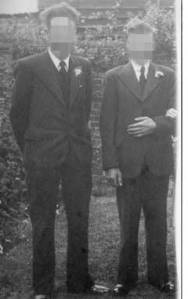
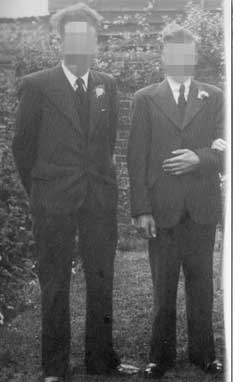
The brothers as they appear in the book (faces obscured)

The brothers as they appear in the book (faces obscured)

So why the note of uncertainty in my title? To explain this I want to digress by describing an image which came into my mind while thinking about it. A few years back, the local people where I live produced a book about our village’s history. An appeal went out for any period photographs that might be borrowed to illustrate the book, and there was a big response. The organiser gave me the task of scanning in all these photos for the book’s publishers, and one them sticks in my mind. It showed two brothers who were local characters during the 1930s standing in a garden, and a closer examination showed that it had been taken at a wedding. They are wearing their best suits, and are sporting buttonholes. Why is the setting not so immediately obvious? Because the photo had been crudely ripped in two down the middle, with both the brothers in the left half. We can see that one of them is the groom, and that the missing right half contained his bride – only her hand is visible, nestling in the crook of his arm.

I found this mute evidence of some anguished estrangement from the past rather moving. What had seemed like a happy union at the time now had the feminine half of it expunged by someone who was determined that she no longer deserved any place in their thoughts. Yes – you get my drift. The enterprise of science now prefers to go it alone along its own, masculine, analytical path, with any attendant mystery ripped out of the picture, leaving only the barest hint. (See my thoughts on atheism in the previous post.)

It’s worth returning to Newton’s own imagery and repeating the often-quoted passage he wrote towards the end of his life:

I do not know what I may appear to the world, but to myself I seem to have been only like a boy playing on the sea-shore, and diverting myself in now and then finding a smoother pebble or a prettier shell than ordinary, whilst the great ocean of truth lay all undiscovered before me.

Although he was an arrogant man in his personal dealings (and the opening phrase here hints at how conscious he is of his reputation), I don’t believe this to be mock-modesty. He also was genuinely pious, and all too aware of the mystery surrounding what he had learned of the universe. Today, we look forward to finishing the task of enumerating the pebbles and shells, and are happy to ignore the ocean. In this sense we are more arrogant than he was, and that’s the source of my doubt as to whether we are really Newtonians now.


Ackroyd, Peter: Newton. Vintage Books, 2007
Gardening Leave

Commuting days until retirement: 499

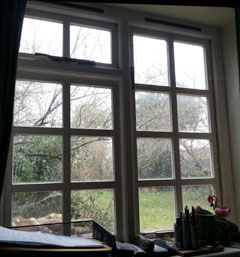
A cold, windy garden, seen from a warm study

A cold, windy garden seen from a warm study

A day off, supposedly to do some gardening, but the sub-zero wind is keeping me indoors. Delicate plants, we office workers.

A chance, at any rate, to reflect on that back and forth journey that the rest of my fellow commuters have resumed for the week. When you look at all those other blank faces on the train, you do wonder about what’s behind them. When they look around at their fellow passengers (carefully, so as not to catch anyone’s eye), what are they thinking about this repetitive enterprise that we are all involved in? Why does it take place – beyond, that is, our individual needs to make a living? Backwards and forwards – reciprocal motion, like the pistons in a car engine. The pistons keep the car moving, irrespective of where it’s going, and of course we commuters, busy driving the engine of society, have no more idea than do the pistons where our vehicle is headed.

No doubt that is unfair to some, who have occupations with a very explicit social purpose. But I’d guess that the majority of us work for private companies, and are driven by the profit motive – a force as amoral as the torque of the car engine, which may be propelling the car towards sunlit uplands of some sort – or over a cliff edge. The difference in our case, of course, is that there’s no driver, no consciously directed intention, no steering wheel.

Or is there? Here we could head into either politics or religion, those two traditionally taboo topics of polite conversation. But it’s religion I’m thinking of. A few posts ago I referred to a Bible-reading passenger sitting right next to me on the train. I see such people regularly, and no doubt they are quite clear about the purpose question. But the rest of us?

Winning the argument

It seems as if the atheists are currently winning the argument. Once rather less focused, nowadays they have some strident and articulate standard-bearers. This has perhaps lent some conviction to the waverers among us. There was a time when religion, for most, was more of a social badge. My father, for instance, would unhesitatingly write “C of E” (Church of England) on any form that asked for religion, but would never be seen in a church, other than for weddings or funerals. And this wasn’t hypocrisy: he was quite up-front about his beliefs, or lack of them. More recently, most people would mutter something vague to the effect of “Well, I think there must be something…” if asked the religion question.

But now, surveys and censuses show that there are a many more who will happily call themselves atheists, or at least agnostics. The New Atheists, as they now tend to be called, have got across the message that we don’t need a purpose imposed on us from above – we can formulate our own. We don’t, furthermore, require a God or a scriptural set of rules in order to tell right from wrong. And our sense of wonder has its needs catered for by the impressive discoveries of science.

So I think, on the face of it, I have pretty good credentials as an atheist. I more or less agree with the above statements; I don’t believe in an old man in the sky, or some more diffuse entity of which he is a personification; and creationism seems to me a ragbag of prejudice, ignorance and wishful thinking, as opposed to the coherent and justified body of theory which evolutionary biology gives us. Large, received bodies of doctrine from organised religion I am unable to swallow. So why is it, that if I see, for a example, a TV debate between an atheist and an apologist of religion, I feel myself instinctively sympathising with the religious point of view? (That’s assuming the religious side doesn’t represent creationism, or some swivel-eyed variety of fundamentalism.)

Stop worrying

Could it be the unbearable smugness which seems to hang like a cloud around the atheist programme? Individually, the most vocal atheists seem to be perfectly decent people, and some – for example Dawkins and Hitchens – are (or were) brilliant writers in their different ways. But somehow the public face of the movement seems to patronise us, with its inverted holier-than-thou expression.

That ghastly bus advertising campaign didn’t help: for those who don’t know it, there was an atheist-sponsored poster campaign on London buses a few years back, with the slogan ‘THERE’S PROBABLY NO GOD. SO STOP WORRYING AND ENJOY YOUR LIFE.’  Of the many reasons why this is objectionable, it’s difficult to pick out the worst. I would go for the fact that many people are worried a lot of the time, and not enjoying their lives, and for whom the existence of god is the last thing on their minds. So to be be dogged by fatuous slogans such as this does not make things any easier for them.

At least the campaign provided us with a bit if fun, when a religious group complained to the Advertising Standards Authority (ASA). The advertising code of practice lays down that ads must be “Legal, Decent, Honest and Truthful’. Well, we can probably get away with the first three here, so that leaves the issue of truthfulness. Which leaves the hapless ASA with the task of ruling on the probability of the existence of God. I have heard of no outcome to this, so perhaps they are still deliberating. Or maybe they judged the probability of the existence of God to be the same as that of Carlsberg being the best lager in the world.

Stuff and experience

No – for me, what is most importantly wrong with the atheist agenda is what it leaves out, what its vision simply doesn’t encompass. There are many aspects to this, so let’s start with the moral one. Of course, we can agree, our morals don’t come direct from the ten commandments. or any other body of doctrine. They come from the fact that we are sentient, conscious beings, who know what it is to suffer, and understand the importance of not inflicting such suffering on other beings – and of promoting their happiness and wellbeing.

That of course, I know, is a massive oversimplification, culturally, historically and emotionally – but it still has at its heart this question of consciousness, of private experience. No scientific theory yet has come anywhere near providing an account of this which can assimilate it into our account of the physical world. There’s ‘stuff’, and there’s ‘experience’. Science deals with the first; morality has more to do with the second. I’d maintain that the question of how, or whether, we can unify our knowledge of the two lies at present outside science, and will remain so unless science becomes a very different kind of enterprise.

These mysteries are, I would maintain, part of what religion is a response to – they are its stock-in-trade, what it is most comfortable with. But for the atheist/materialist agenda it’s necessary to assert that science has either explained them already, or will have them under its belt after some more investigation. I would respectfully disagree – and hope to expand on this in future posts.

Antiversary

Commuting days until retirement: 500

Five hundred days to go – I couldn’t let that go by without comment. It’s a sort of backwards anniversary, or anti-anniversary. Let’s call it an antiversary.

So here’s something to celebrate it:

Antiverse

A quincentennially starred antiversary
Needs observance that’s more than just cursory.
Despite notions you’ve got
From my profile shot
I’ve come a long way from the nursery.

My hope from today’s antiversary
That my pension will build to a bursary
Means I cannot start shirking
But must go on working –
For time is a fearsome adversary.

(If you’re a pronunciation freak, I’m sorry about the last line. I was out of rhyme words.)

More commuter’s tales

Commuting days until retirement: 503

This morning’s train journey had something of a surreal air about it, and the oddities started at the ticket office. This was the day when I surrender my monthly arm and leg in exchange for a season ticket. There was one passenger ahead of me, already at the window, and it was clear from his tone of voice that all was not well.

‘But I need it to claim the expenses!’
‘Well look, I’ve done you a photocopy. ‘
‘But they don’t accept photocopies! I have to have the ticket!’
‘I can’t do that. It’s railway property.’
‘I only need my ticket!’
‘You don’t buy a ticket. You buy the journey.’

This last point proffered with smug satisfaction, as an argument clincher.

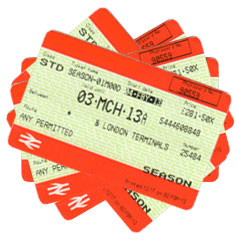
ticketsAnd after only a few more exchanges, to my surprise, the passenger gave up. I wouldn’t have. And the clerk in this office had always seemed quite affable – I hadn’t put him down as a jobsworth. I thought of the vast majority of tickets I have ever bought, which have ended up in the bin at home. Will the railway send the bailiffs round one day, to enforce a mass repossession of these cherished items? The sheer Orwellian absurdity is difficult to believe. If the clerk had just given back the ticket, would he have ended up hanging by the wrists in some fearful house of correction for errant railway employees? I can just imagine it, under one of the dingier railway arches near the back end of Waterloo, where screams are heard on dark foggy nights.

‘Now once again. Who do the tickets belong to?’
(Yelp of pain)
‘Yes, that’s right – they belong to us.’

I had to catch the later train – the earlier one would have been before the ticket office opened. So a few minutes later I was on it, standing room only. Once we were under way there was a beep and a throat clearing – the driver had something to say. Drivers on the PA system vary in my commuting experience, from completely taciturn (a blessing if you’re reading) to chronic verbal diarrhoea. This one was well to the latter end of the scale.

I have an announcement, particularly for those who have joined the train at the last two stops.’ (Pause for effect.) ‘The state of the train is not at all what it should be today. It’s filthy. I can only apologise for the state of it. Last night we had late night revellers using it as a pigsty. Frankly I’m embarrassed to be driving this train. It’s a mess.

At this point, passengers are nervously catching each other’s eyes, in the British manner, not sure whether they dare to embark on a shared joke. They don’t quite manage it, not in my carriage, anyway. I look around, and it doesn’t look that much different from usual. I catch sight of one beer can under a seat, but that’s all. Meanwhile the driver is getting into his stride.

And this morning we had a cleaner off sick. So that’s why the train is in this state. It’s not good enough. It’s a shambles. You don’t deserve to be subjected to this.

It seems as if our main function is to be witnesses to this man’s grief.

The only crumb of comfort I can offer you is that I will be making representations at the highest levels about this. It’s unforgivable and something must be done.

Well, I hope for his sake that these higher echelons will have a sympathetic ear for him. But I rather suspect that they’ll be too busy counting their precious bits of cardboard.

Bus travel, a politician and a dark brown comestible

Commuting days until retirement: 504

These days the last leg of my journey into work is by bus. This is because, given my advanced age, I qualify for a bus pass, which saves me enough money to make it worthwhile. What hadn’t really struck me was, as my daughter had already told me, how much more civilised a form of transport it is than the tube (underground or metro, for non-UK readers). Instead of a brutal ten minutes of shoulder-to-shoulder, er – (as I try to think of a suitably claustrophobic word here, my spookily intelligent phone keyboard suggests ‘wrongness’. OK – ‘shoulder-to-shoulder wrongness’ will do very well.) So instead of ten minutes of that, a long way underground, I have twenty minutes of mature reflection as I survey busy London streets from wide top deck windows. And the frequent background of Eastern European chatter creates a sense of being delocalised, as if I am viewing the frenetic urban activity below from some privileged, remote vantage point.

And here's some proof, found in the back of a drawer by my sister. Also proves my age, unfortunately.

And here’s some proof, found in the back of a drawer by my sister. Also proves my age, unfortunately.

As this mobile ivory tower lurches and judders around corners and through traffic lights I sometimes think of a dictum of Margaret Thatcher’s: ‘If a man of over 26 finds himself on a bus he must consider himself a failure.’ I’m 64, so I don’t know what that makes me. And in this connection I also think of a school friend of mine, who, when we were about 12 or so, was quite single-mindedly fascinated by everything to do with buses. I caught the bug too, and for a year or two would join him on ‘Red Rovers’ (bus tickets that gave you travel all over London for a day), visit bus garages, and even take black-and-white photos of buses with our Kodak Brownies (remember them?). I can recall my mother gawping at my photo album, and obviously wondering what sort of psychological backwater her son had ended up in.

Well, (typically for me) the enthusiasm didn’t last long. But my friend proceeded to a career in management with London Transport, while marrying and raising a family. I haven’t seen him for a while, but I’ve heard that now, with that responsibility discharged, he is doing what he always really wanted to do – he drives a bus. And this seems to me to be a resounding success in life, although it wouldn’t register on the Thatcher scale.

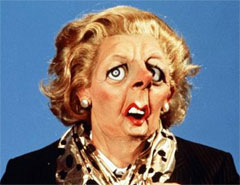
Before expanding on the character of the former prime minister I naturally checked by Googling the quotation, to only to find that she never actually said it. It’s a sobering experience, having launched your carefully engineered, watertight Titanic of an argument, only to have it encounter the iceberg of a factual inaccuracy. My lifeboat will have to be the thought that it wouldn’t have been attributed it to her unless it had seemed to fit. And the point I was going to develop – which is now thrashing about in the freezing water but still alive – was how essentially one-dimensional her outlook was. Much more a conviction politician than many others, and one of immense strength of personality – but as we all know, a current gathers greater force when constricted into a narrow channel.

Margaret Thatcher, as depicted in TV's Spitting Image

Margaret Thatcher, as depicted in TV’s Spitting Image

Perhaps this accounts for how polarised people’s opinions about her tended to be. Either you admired the ‘iron lady’ strength of character, or if your politics differed, then what you saw as forceful wrong-headedness inspired a forceful dislike. Thus she became the Marmite of politicians: I don’t know if this is known beyond the UK, but Marmite is a yeast extract spread which is famous for being either adored or reviled – indifference is rare. (I’m an exception; I can take it or leave it, and I mostly leave it.)

Which takes me back to a residential poetry course I did a few years ago. One of the tutors was the poet Sean O’Brien. When the Marmite controversy arose at breakfast one morning, he nailed his colours firmly to the Marmite-lovers’ mast. (On Thatcher, his politics would put him in the other camp – see for example his wonderful poem Cousin Coat.)  I hope he won’t mind me playing fast and loose with his copyright, but the next day the following little poem appeared, and has since found its way into his collection November.

marmite

The Plain Facts of the Matter

There are two tribes this world can boast:
The Marmite-lovers and the damned.
Fact is, though, everybody’s toast
Whatever breakfast they’ve got planned.

It’s not for us to turn away
The sort who shun the dark brown jar,
But sure as sure come Judgement Day
The Lord will know who His folk are.